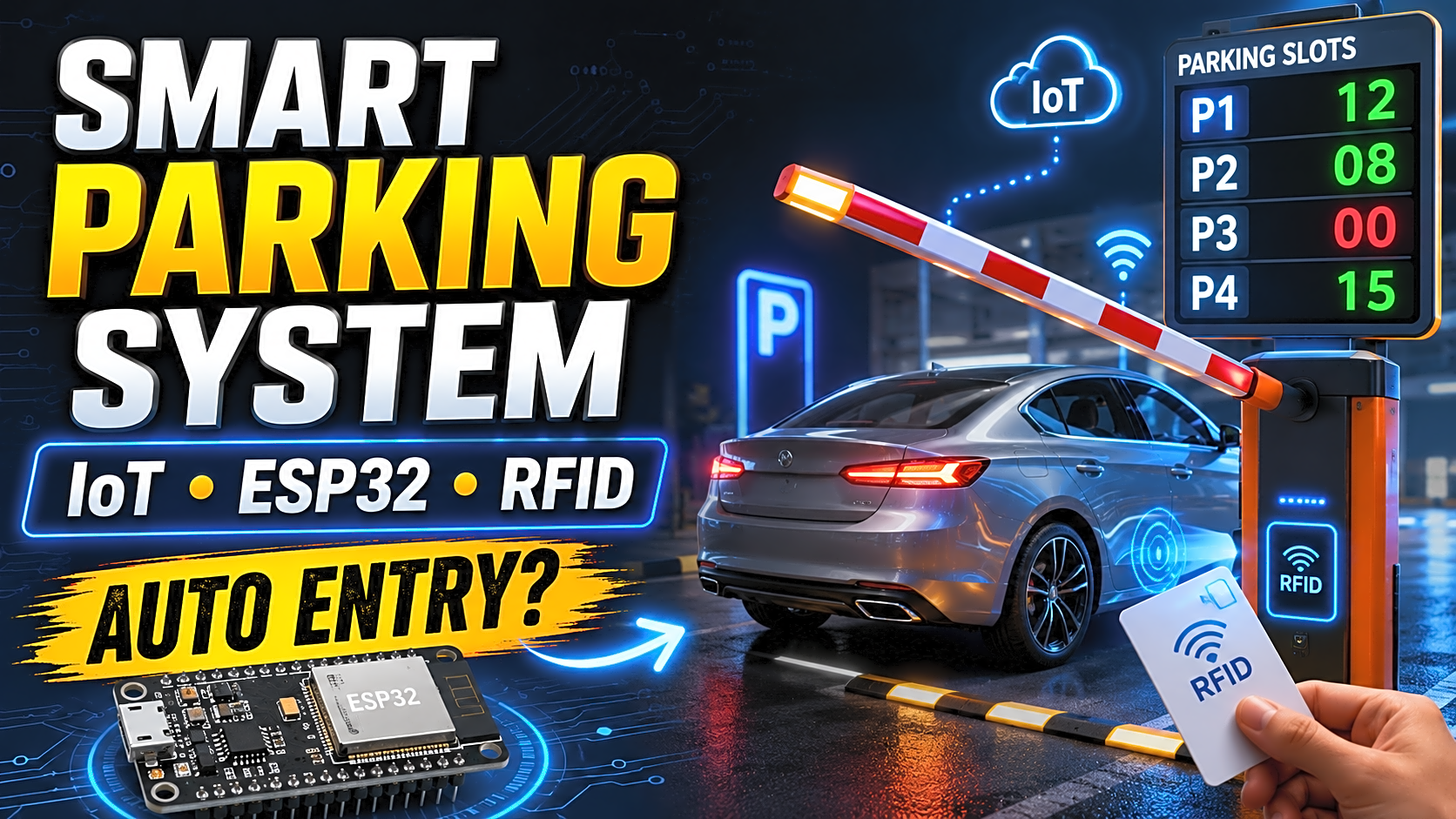
Smart Parking System Project for Engineering Students
Table of Contents
- Quick Answer
- What is a Smart Parking System?
- How Smart Parking Systems Work
- Required Components
- Hardware Cost Estimation
- System Architecture
- Circuit Diagram Explanation
- Step-by-Step Implementation
- Firebase & MQTT Integration
- RFID Authentication Workflow
- Smart Parking Source Code Workflow
- Real-World Applications
- Common Challenges & Troubleshooting
- Viva Questions
- Future Enhancements
- FAQs
- Conclusion
Quick Answer
A Smart Parking System Project is an IoT-based parking management solution that uses sensors, RFID, ESP32/Arduino, cloud databases, and mobile applications to monitor parking slot availability in real time. It helps reduce traffic congestion, fuel wastage, and parking delays while improving automation and urban mobility.
What is a Smart Parking System?
A Smart Parking System is an intelligent parking automation solution that detects vehicle occupancy using sensors and updates parking availability through cloud-connected systems.
Modern smart parking solutions are widely used in:
- Smart cities
- Shopping malls
- Airports
- Hospitals
- Railway stations
- IT parks
- Universities
These systems support:
- Real-time slot monitoring
- RFID-based vehicle authentication
- Mobile app reservation
- Automated billing
- Digital payment integration
- AI-based vehicle recognition
With the rise of India’s Smart Cities Mission, IoT-based parking automation has become a major engineering innovation area.
How Does a Smart Parking System Work?
Basic Workflow
- Ultrasonic or IR sensors detect vehicle presence
- ESP32 or Arduino processes sensor data
- Data is transmitted using WiFi and MQTT protocol
- Firebase Realtime Database stores slot status
- Parking availability updates instantly
- Users check free slots via mobile app or dashboard
- RFID authentication automates entry and exit
Technologies Used in Smart Parking Systems
|
Technology |
Purpose |
|
Arduino UNO |
Basic controller |
|
ESP32 |
WiFi + IoT connectivity |
|
Raspberry Pi |
Advanced processing |
|
RFID Module |
Vehicle authentication |
|
Ultrasonic Sensor |
Slot detection |
|
IR Sensor |
Occupancy sensing |
|
Firebase |
Real-time database |
|
MQTT Protocol |
IoT communication |
|
OpenCV |
Number plate recognition |
|
Android Studio |
Mobile app development |
|
Arduino IDE |
Controller programming |
Hardware Components Required
Core Components
- ESP32 development board
- Ultrasonic sensors
- RFID RC522 module
- Servo motor
- LCD display
- Jumper wires
- Breadboard
- Power supply
- WiFi router
Optional Advanced Components
- Raspberry Pi
- Camera module
- GSM module
- Relay module
- BLE beacon system
Smart Parking System Hardware Cost Estimation
|
Component |
Approximate Cost (INR) |
|
ESP32 Board |
₹450–₹700 |
|
Ultrasonic Sensor |
₹80–₹150 |
|
RFID Module |
₹150–₹300 |
|
Servo Motor |
₹120–₹250 |
|
LCD Display |
₹150–₹350 |
|
Power Supply |
₹200–₹400 |
|
Miscellaneous Wiring |
₹200–₹500 |
Estimated Total Cost
Beginner Project:
₹1,500 – ₹3,000
Advanced IoT Project:
₹5,000 – ₹15,000
Smart Parking System Architecture
Hardware Layer
- Sensors detect occupancy
- RFID authenticates vehicles
- Servo motor controls gate
Processing Layer
- ESP32 processes sensor data
- Arduino IDE handles embedded programming
Cloud Layer
- Firebase stores real-time parking data
- MQTT protocol manages communication
Application Layer
- Android app displays parking availability
- Admin dashboard tracks analytics and billing
Circuit Diagram Explanation
A typical smart parking system circuit includes:
- Ultrasonic sensors connected to ESP32 GPIO pins
- RFID module connected through SPI communication
- Servo motor attached for automatic gate control
- LCD connected using I2C interface
- WiFi-enabled ESP32 sends real-time data to Firebase
Important Engineering Tip
Always calibrate ultrasonic sensors properly to avoid false parking detection.
Step-by-Step Smart Parking System Implementation
Step 1: Define Project Scope
Decide whether the project includes:
- Slot monitoring
- RFID authentication
- Mobile app integration
- Cloud dashboard
- AI vehicle detection
Step 2: Configure Hardware
Recommended beginner setup:
- ESP32
- 2 Ultrasonic sensors
- RFID module
- Servo motor
- LCD display
Step 3: Design the Circuit
Connect:
- Sensors to GPIO pins
- Servo motor to PWM pin
- RFID through SPI
- LCD via I2C communication
Step 4: Program the ESP32
Using Arduino IDE:
- Read sensor data
- Detect occupancy
- Push updates to Firebase
- Trigger gate automation
Step 5: Configure Firebase Database
Store:
- Slot status
- Vehicle ID
- Entry time
- Payment status
Firebase enables real-time synchronization between hardware and mobile applications.
Step 6: Build User Dashboard
Develop:
- Android application
- Web dashboard
- Admin analytics panel
Key features:
- Live parking status
- Slot reservation
- Revenue tracking
- Vehicle history
Step 7: Testing & Calibration
Test:
- Sensor accuracy
- WiFi latency
- RFID authentication
- Cloud synchronization
- Servo response timing
MQTT & Firebase Integration Workflow
Why MQTT?
MQTT protocol is lightweight and ideal for IoT communication.
Workflow
- ESP32 publishes slot data
- MQTT broker transmits information
- Firebase updates occupancy status
- Mobile dashboard refreshes instantly
This architecture improves scalability for smart city deployments.
RFID Authentication Flow
Authentication Process
- Vehicle approaches entry gate
- RFID card is scanned
- ESP32 validates credentials
- Servo motor opens gate
- Entry log updates in Firebase
RFID integration improves:
- Security
- Automation
- Vehicle tracking
Smart Parking System Source Code Workflow
Recommended Project Structure
Backend
- Firebase APIs
- MQTT communication scripts
Embedded Code
- Sensor detection logic
- RFID validation
- Servo control
Frontend
- Android app
- Admin dashboard
Recommended Languages
|
Module |
Language |
|
Embedded System |
C/C++ |
|
Dashboard |
JavaScript |
|
Mobile App |
Java/Kotlin |
|
AI Module |
Python |
Smart Parking System vs Traditional Parking
| Feature | Traditional Parking | Smart Parking System |
|---|---|
| Slot Detection | Manual | Automated |
| Billing | Manual | Digital |
| Vehicle Tracking | Limited | Real-time |
| Traffic Congestion | High | Reduced |
| User Experience | Poor | Efficient |
| Analytics | None | Advanced |
Real-World Applications
Smart parking systems are actively deployed in:
- Airports
- Metro stations
- Corporate campuses
- Smart city infrastructure
- Shopping complexes
AI-powered parking systems in Indian smart cities help reduce:
- Fuel wastage
- Traffic congestion
- Illegal parking
Common Challenges & Troubleshooting
Sensor Calibration Issues
Improper calibration causes false occupancy detection.
Network Latency
Weak WiFi connectivity delays real-time updates.
Database Synchronization Errors
Poor schema design affects dashboard performance.
Power Consumption
Large deployments require optimized energy management.
Security Vulnerabilities
Unencrypted IoT communication can expose system data.
Common Viva Questions
What is the purpose of a smart parking system?
To automate parking management and improve parking efficiency.
Why is ESP32 preferred over Arduino UNO?
ESP32 includes built-in WiFi and better IoT support.
Which database is best for IoT parking systems?
Firebase Realtime Database is commonly used.
What are the advantages of RFID?
- Fast authentication
- Better security
- Automated access control
What is MQTT used for?
MQTT enables lightweight IoT communication between devices and servers.
Future Scope of Smart Parking Systems
Future innovations include:
- AI-based parking prediction
- Automatic number plate recognition
- Autonomous vehicle integration
- Blockchain payment systems
- Smart city traffic integration
- Predictive analytics using machine learning
The global smart parking industry is expected to grow significantly with increasing urbanization and IoT adoption.
Expert Tips for Final Year Students
- Use ESP32 instead of Arduino UNO for IoT scalability
- Add Firebase integration for innovation marks
- Include UML and DFD diagrams in documentation
- Prepare a project abstract and IEEE-style report
- Add real-time dashboard screenshots
- Demonstrate live sensor testing during viva
FAQ Section
What is a Smart Parking System Project?
A smart parking system project is an IoT-based parking automation solution that detects available parking slots and updates parking data in real time.
Which controller is best for smart parking projects?
ESP32 is preferred because it supports built-in WiFi, cloud integration, and IoT communication.
Can I build a smart parking system using Arduino?
Yes. Arduino UNO is suitable for beginner-level implementations.
What is the cost of a smart parking project?
A basic project costs around ₹1,500–₹3,000, while advanced implementations may exceed ₹10,000.
Which sensors are used in smart parking systems?
Common sensors include:
- Ultrasonic sensors
- IR sensors
- RFID modules
- Camera modules
Is Smart Parking System a good final year project?
Yes. It demonstrates practical knowledge in:
- IoT
- Embedded systems
- Automation
- Cloud computing
- Mobile app development
What programming languages are required?
- C/C++ for Arduino and ESP32
- Python for AI modules
- Java/Kotlin for Android apps
- JavaScript for dashboards
Conclusion
A Smart Parking System Project is one of the most practical and industry-relevant IoT final year projects for engineering students.
It combines:
- Embedded systems
- Cloud computing
- RFID automation
- Sensor integration
- Mobile application development
With increasing smart city adoption and parking automation demand, this project offers strong academic and commercial value.
Students looking for:
- smart parking system source code
- downloadable project reports
- circuit diagrams
- implementation support
- live demos
can explore complete IoT project solutions on FileMakr.