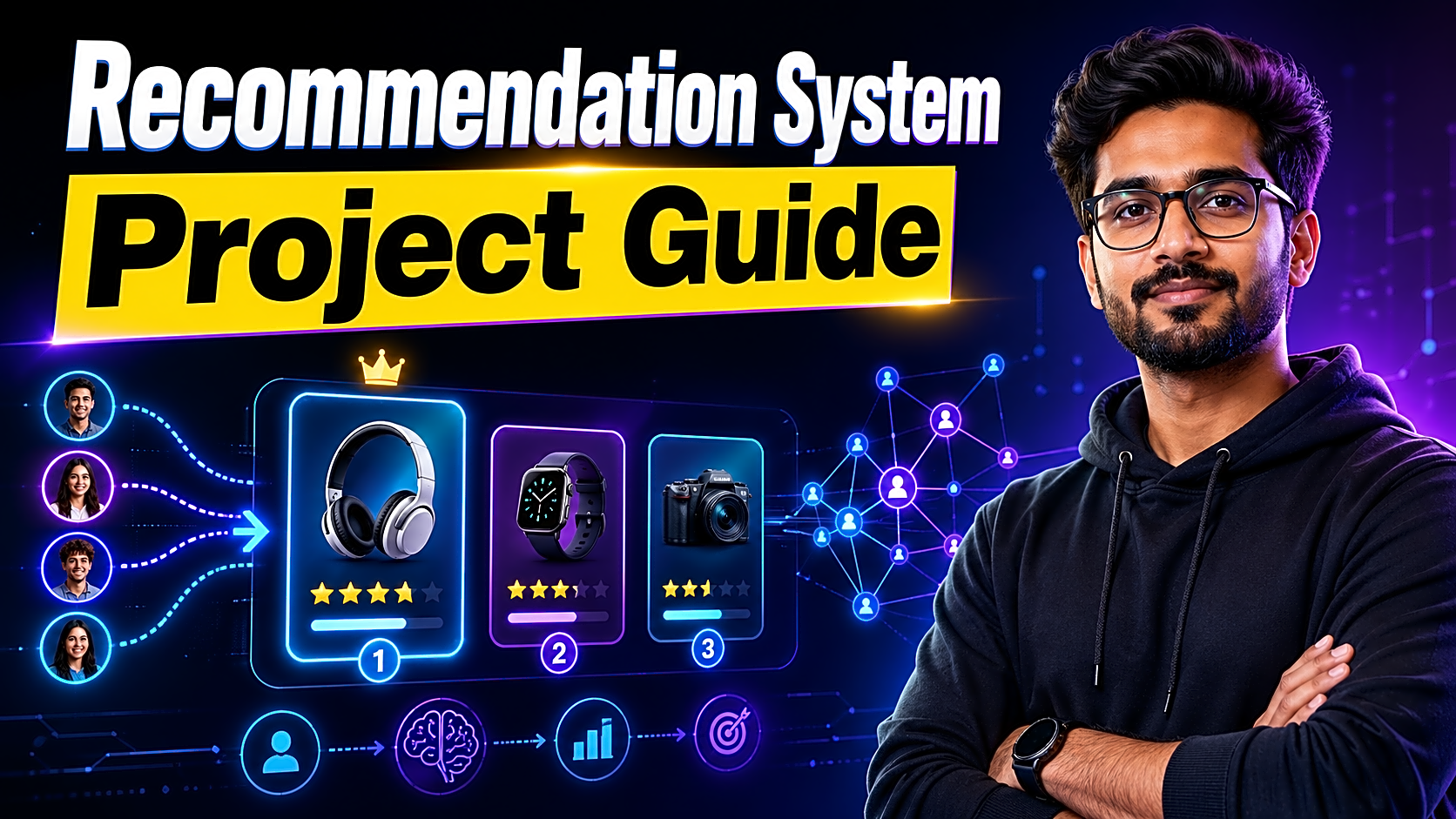
A recommendation system project is a machine learning project that suggests relevant items to users based on ratings, preferences, search history, item similarity, or user behavior. Final-year students can build it using Python, pandas, scikit-learn, TF-IDF, cosine similarity, collaborative filtering, or a hybrid recommendation model.
For a strong academic submission, your project should include a dataset, preprocessing, recommendation algorithm, user interface, admin panel, database, evaluation metrics, report, diagrams, screenshots, and viva preparation.
Why Choose a Recommendation System Final Year Project?
A recommendation system final year project is practical, industry-relevant, and easy to demonstrate. You already see recommender systems on Netflix, Amazon, YouTube, Spotify, shopping apps, job portals, and e-learning platforms.
This project is suitable for B.Tech, BE, BCA, MCA, BSc IT, MSc CS, and diploma students because it combines:
- Python programming
- Machine learning
- Data preprocessing
- Database design
- Web development
- User/admin modules
- Academic documentation
- Real-world use cases
For beginners, a movie recommendation system using cosine similarity is a good choice. For advanced students, a hybrid recommendation system with ratings, user behavior, and feedback storage can create a stronger submission.
Need ready-to-run code? You can explore FileMakr’s final year project source code section for project source code, reports, and documentation support.
What Is a Recommendation System?
A recommendation system, also called a recommender system or recommendation engine, predicts what a user may like next. It analyzes available data and generates personalized suggestions.
For example:
- If a user likes action movies, the system may recommend similar thriller or action movies.
- If a customer buys a laptop, an e-commerce system may recommend a laptop bag or mouse.
- If a student completes a Python course, an e-learning system may recommend machine learning or Django courses.
The main goal is personalization. Instead of showing the same results to every user, the system ranks and displays items based on relevance.
Types of Recommendation System Projects
1. Content-Based Recommendation System
A content-based recommendation system suggests items similar to what the user already liked. It uses item features such as title, genre, category, tags, keywords, description, cast, author, or product type.
Example:
If a user likes a Python course, the system may recommend machine learning, Django, data science, or AI courses.
Common techniques:
- TF-IDF vectorization
- CountVectorizer
- Cosine similarity
- Feature extraction
- Text preprocessing
Best for: movie, book, course, product, and news recommendation projects.
2. Collaborative Filtering Recommendation System
Collaborative filtering recommends items based on user behavior, ratings, or interaction history. It assumes that users with similar preferences may like similar items.
Example:
If User A and User B both liked five similar movies, and User B liked one more movie, that movie may be recommended to User A.
Types:
- User-based collaborative filtering
- Item-based collaborative filtering
- Matrix factorization
Best for: e-commerce, OTT platforms, music apps, product ratings, and large user-item datasets.
3. Hybrid Recommendation System
A hybrid recommendation system combines content-based filtering and collaborative filtering. It usually gives better results because it uses both item features and user behavior.
Best for: major projects, advanced final-year projects, research-based submissions, and real-world personalization systems.
Recommendation System Algorithm Comparison
|
Method |
Data Required |
Difficulty |
Best Use Case |
Final-Year Suitability |
|
Content-Based Filtering |
Item features, tags, descriptions |
Beginner |
Movie, book, course recommendation |
Excellent for mini projects |
|
User-Based Collaborative Filtering |
User ratings/interactions |
Intermediate |
Movie, music, product recommendation |
Good for major projects |
|
Item-Based Collaborative Filtering |
Item interaction patterns |
Intermediate |
E-commerce and OTT apps |
Strong academic value |
|
Matrix Factorization |
Large rating matrix |
Advanced |
Rating prediction systems |
Best for advanced students |
|
Hybrid Recommendation |
User data + item features |
Advanced |
Real-world recommendation engine |
Excellent for high-scoring projects |
Best Dataset for Recommendation System Project
Choosing the right dataset makes implementation easier and improves project quality.
|
Dataset |
Best For |
Difficulty |
Recommended Algorithm |
|
MovieLens |
Movie recommendation system |
Beginner |
Collaborative filtering, matrix factorization |
|
TMDB Movie Dataset |
Movie recommendation with metadata |
Beginner |
Content-based filtering |
|
Kaggle Product Datasets |
Product recommendation |
Intermediate |
Content-based or hybrid filtering |
|
Amazon Reviews Dataset |
Product rating recommendation |
Advanced |
Collaborative filtering |
|
Book-Crossing Dataset |
Book recommendation system |
Intermediate |
Collaborative filtering |
|
Course Dataset |
E-learning recommendation |
Intermediate |
Content-based filtering |
|
Job Posting Dataset |
Job recommendation system |
Advanced |
Content-based or hybrid filtering |
For students, MovieLens and TMDB-style movie datasets are easiest to explain in viva because the output is simple and visual.
Recommended Tech Stack
For most final-year students, this stack is practical and easy to present:
|
Layer |
Recommended Tools |
|
Frontend |
HTML, CSS, Bootstrap, React |
|
Backend |
Python Flask or Django |
|
Database |
SQLite, MySQL, PostgreSQL |
|
Machine Learning |
pandas, NumPy, scikit-learn |
|
Recommendation Logic |
TF-IDF, cosine similarity, collaborative filtering |
|
Visualization |
Matplotlib, dashboard charts |
|
Deployment |
Localhost, PythonAnywhere, Render, college lab server |
For beginners, Flask with SQLite is simple. For advanced students, Django with MySQL and authentication looks more professional. You can also browse Python final year project source code for implementation-ready Python project ideas.
Step-by-Step Implementation Guide
Step 1: Select One Project Domain
Choose one clear domain. Do not mix movies, products, books, jobs, and courses in the same project.
Best choices:
- Beginner: movie recommendation system
- Intermediate: product recommendation system
- Advanced: hybrid course or job recommendation system
Step 2: Collect and Clean the Dataset
Your dataset should contain item details and, if possible, user interaction data.
Common preprocessing tasks include:
- Remove duplicate records
- Handle missing values
- Convert text to lowercase
- Clean special characters
- Combine important features
- Create a final feature column
- Prepare rating or interaction data
Step 3: Choose the Recommendation Algorithm
Use content-based filtering if your dataset has item descriptions, categories, tags, or genres.
Use collaborative filtering if your dataset has user ratings, purchases, clicks, or interactions.
Use hybrid filtering if you want a more advanced machine learning recommendation system project.
Step 4: Build the Model in Python
A simple content-based movie recommendation model can follow this workflow:
import pandas as pd
from sklearn.feature_extraction.text import TfidfVectorizer
from sklearn.metrics.pairwise import cosine_similarity
movies = pd.read_csv("movies.csv")
movies["features"] = (
movies["title"].fillna("") + " " +
movies["genres"].fillna("") + " " +
movies["overview"].fillna("")
)
tfidf = TfidfVectorizer(stop_words="english")
feature_matrix = tfidf.fit_transform(movies["features"])
similarity = cosine_similarity(feature_matrix)
def recommend_movie(movie_title, top_n=5):
index = movies[movies["title"].str.lower() == movie_title.lower()].index[0]
scores = list(enumerate(similarity[index]))
scores = sorted(scores, key=lambda x: x[1], reverse=True)[1:top_n+1]
movie_indices = [i[0] for i in scores]
return movies[["title", "genres"]].iloc[movie_indices]
print(recommend_movie("Avatar"))
This code creates a TF-IDF feature matrix, calculates cosine similarity, and returns the top recommended movies.
Step 5: Create the Web Application
Your web app should allow users to search for an item and view recommendations.
Important pages:
- Home page
- User registration/login
- Search page
- Recommendation result page
- User dashboard
- Admin dashboard
- Feedback/rating page
Step 6: Add Database Tables
A complete project should include database design, not only a notebook.
|
Table |
Purpose |
|
users |
Stores user registration and login details |
|
items |
Stores movies, books, products, jobs, or courses |
|
ratings |
Stores user ratings or feedback |
|
recommendations |
Stores recommendation history |
|
feedback |
Stores user response to recommendations |
|
admin |
Stores admin login and management data |
Step 7: Evaluate the Recommendation Model
Evaluation improves academic quality and viva confidence.
|
Metric |
Meaning |
|
Precision@K |
How many recommended items are relevant in the top K results |
|
Recall@K |
How many relevant items were successfully recommended |
|
RMSE |
Measures rating prediction error |
|
MAE |
Measures average absolute prediction error |
|
Hit Rate |
Checks whether at least one relevant item appears in recommendations |
Even if your project is simple, include at least Precision@K or user feedback score in your report.
Recommendation System Architecture
A standard architecture flow is:
User Input → Dataset → Data Preprocessing → Feature Extraction → Similarity Model → Top-N Recommendation → User Feedback → Database Storage
In your report, explain how data moves through the system. For example, the user searches for a movie, the system extracts similar movies using cosine similarity, ranks the results, displays top recommendations, and stores user feedback for future improvement.
Important Modules to Include
|
Module |
Features |
Viva Importance |
|
User Module |
Register, login, search, view recommendations, rate items |
High |
|
Admin Module |
Manage users, upload dataset, add/edit/delete items |
High |
|
Recommendation Module |
Preprocessing, similarity calculation, ranking |
Very High |
|
Report Module |
Charts, logs, feedback, model performance |
Medium |
|
Feedback Module |
User ratings and recommendation response |
High |
For more ML-based examples, visit machine learning projects with source code.
Common Problems and Solutions
Cold-Start Problem
The cold-start problem occurs when the system has no data for a new user or new item.
Solutions:
- Ask new users to select interests during signup.
- Recommend popular items first.
- Use content-based filtering for new items.
- Collect ratings and feedback gradually.
Poor Dataset Quality
A weak dataset creates poor recommendations. Use clean datasets with enough item details, ratings, or interaction history.
Only Building a Notebook
A Jupyter notebook is useful for testing, but final-year projects should include a web interface, database, screenshots, report, and viva explanation.
Project Report Format
Your recommendation system project report should include:
- Abstract
- Introduction
- Problem statement
- Objectives
- Literature review
- Existing system
- Proposed system
- System architecture
- Algorithms used
- Dataset description
- Module description
- ER diagram
- DFD
- Use case diagram
- Database design
- Testing
- Output screenshots
- Conclusion
- Future scope
You can also review FileMakr’s B.Tech final year project report support for documentation structure.
Download-Ready Project Checklist
Before submission, make sure your project includes:
- Source code
- Dataset
- Database file
- User module
- Admin module
- Recommendation model
- Screenshots
- ER diagram
- DFD
- UML/use case diagram
- Project report
- PPT
- Viva questions
- Installation steps
Expert Tips for a High-Scoring Project
Start with a simple content-based model, then add collaborative filtering as an enhancement. Add a “Why this item was recommended” explanation to improve transparency. Store user searches, ratings, and feedback in the database. Include charts such as most recommended items, most active users, and rating distribution.
A strong final-year submission is not only about the algorithm. Faculty usually evaluates how clearly you explain the problem, system design, modules, database, testing, and future scope.
Reviewed by: FileMakr Academic Project Team
Last updated: 28 April 2026
Method used: This guide is based on common final-year project evaluation requirements, recommender-system implementation workflows, and student viva preparation patterns.
Recommendation System Viva Questions
1. What is a recommendation system?
A recommendation system is a machine learning-based system that suggests relevant items to users based on preferences, ratings, behavior, or similarity.
2. Which algorithm is best for a recommendation system project?
For beginners, content-based filtering with cosine similarity is best. For advanced students, collaborative filtering or hybrid recommendation is better.
3. What is cosine similarity?
Cosine similarity measures how similar two vectors are. In recommendation systems, it compares item features such as genre, keywords, description, or tags.
4. Which dataset is best for a recommendation system project?
MovieLens is best for rating-based movie recommendation. TMDB-style datasets are good for content-based movie recommendations. Product, book, job, and course datasets can be used depending on your domain.
5. Can I build a recommendation system without machine learning?
Yes, a rule-based recommendation system is possible, but a machine learning-based system is better for final-year academic evaluation.
6. What should be included in a recommendation system project report?
The report should include abstract, objectives, existing system, proposed system, algorithms, dataset, modules, architecture, ER diagram, DFD, testing, screenshots, conclusion, and future scope.
7. Is a recommendation system project good for final year?
Yes. It is practical, industry-relevant, easy to demonstrate, and suitable for students interested in Python, machine learning, data science, and AI.
Conclusion
A recommendation system project is one of the best final-year project choices for students who want to combine machine learning, Python, database design, and web development. It is practical, easy to explain, and connected to real-world platforms like Netflix, Amazon, YouTube, Spotify, job portals, and e-learning apps.
For beginners, a movie or book recommendation system using content-based filtering is a strong starting point. For advanced students, a hybrid recommendation system with ratings, feedback, dashboards, and evaluation metrics can create a higher-scoring submission.
The key is to build more than a model. Add modules, database tables, diagrams, testing, screenshots, report documentation, PPT, and viva preparation.
Next step: Get a ready-to-run recommendation system project with report, PPT, diagrams, and source code from FileMakr’s source code collection.