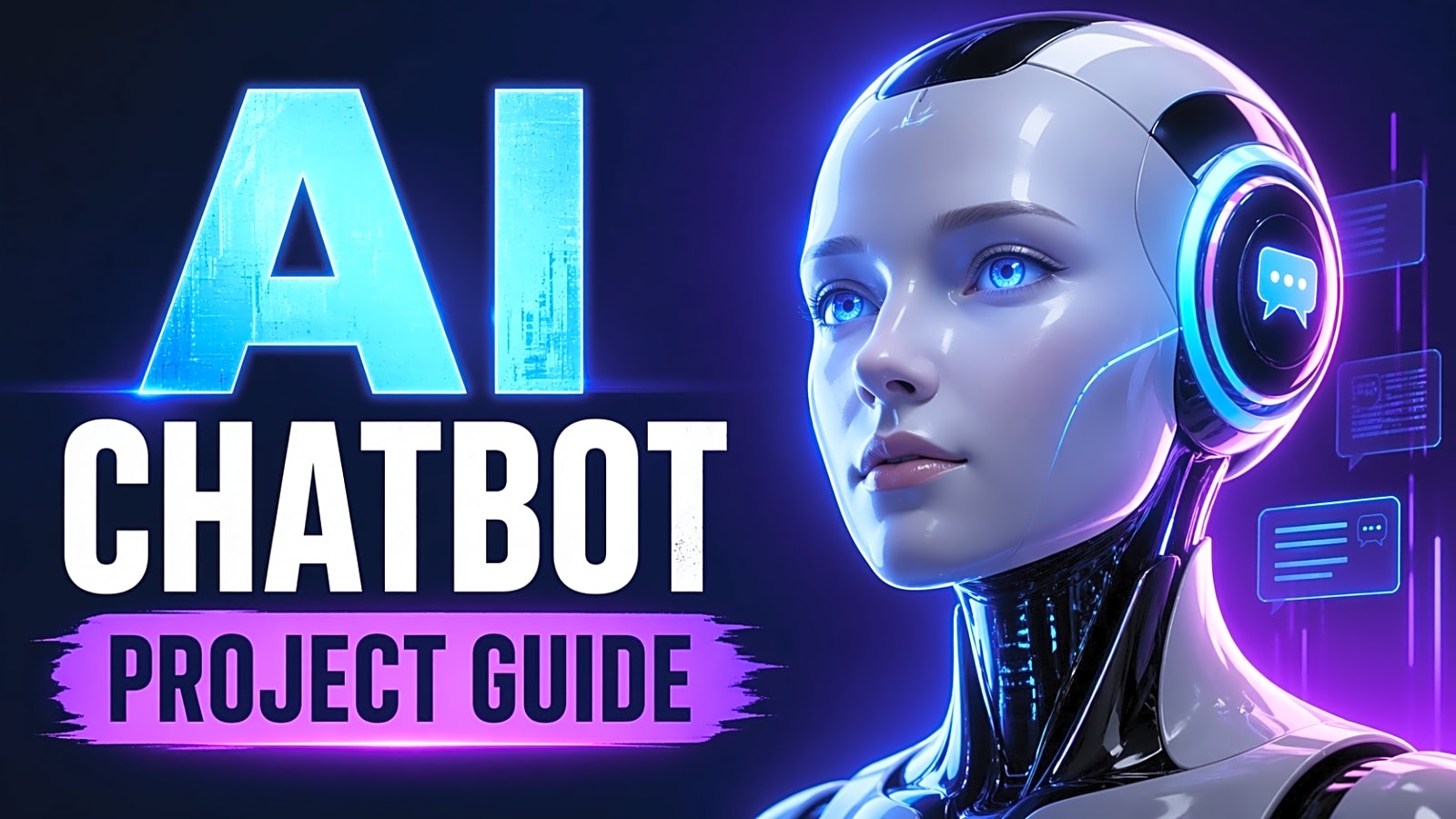
AI Chatbot Project Guide for Final Year Students
Choosing a final year project sounds exciting until you have to scope it properly, build it within deadlines, and explain every module during viva. That is exactly why an AI chatbot project works so well for students. It is practical, easy to demo, flexible in scope, and relevant to current software trends. Python remains a strong choice for student chatbot projects because of its broad developer adoption and AI ecosystem, and Flask is still one of the simplest ways to turn a Python prototype into a usable web app.
Quick Answer
An AI chatbot project is one of the best final year project ideas for students because it combines AI, NLP, Python, databases, and UI into one demo-friendly application. The best option for most students is a domain-specific chatbot such as a college enquiry chatbot project using Python Flask, with features like FAQ handling, chat history, fallback responses, and admin updates. Start simple with a retrieval-based chatbot, then add NLP or AI features only if your time, dataset, and documentation are strong enough.
What Is an AI Chatbot Project?
An AI chatbot project is a software application that accepts user questions, processes the query, identifies intent, and returns a useful response. In an academic setting, it is usually built for a specific use case such as:
- college enquiries,
- placement preparation,
- department FAQs,
- hostel or campus support,
- library help,
- healthcare appointments,
- or e-commerce support.
For final year students, a chatbot project is valuable because it demonstrates:
- problem solving,
- backend development,
- database design,
- NLP basics,
- frontend integration,
- and system documentation.
Why an AI Chatbot Is a Good Final Year Project
A chatbot final year project works especially well because it balances technical depth with presentation simplicity.
Main advantages
- Easy to explain during viva
- Can be built in phases
- Suitable as both a chatbot mini project and chatbot major project
- Demonstrates real-world use
- Lets you combine Python, Flask, NLP, and database modules
- Can be upgraded later with machine learning or LLM features
If you are still comparing topics, this page should also help you decide whether a chatbot is the right fit or whether you should explore other final year project ideas.
Best AI Chatbot Project Ideas by Difficulty
Beginner level
These are best if you want a clean, low-risk submission.
- FAQ chatbot
- college enquiry chatbot
- library enquiry chatbot
- hostel helpdesk chatbot
Intermediate level
These are strong for most BCA, BSc CS, MCA, and engineering students.
- placement preparation chatbot
- department information chatbot
- healthcare appointment chatbot
- student support chatbot with admin panel
Advanced level
These are better when you want a stronger portfolio project.
- NLP chatbot with intent classification
- multilingual chatbot
- document-based chatbot
- AI chatbot with semantic search or LLM assistance
Rule-Based vs NLP vs LLM Chatbot: Which One Should You Build?
|
Type |
Difficulty |
Internet/API Dependency |
Viva Explainability |
Best For |
|
Rule-based chatbot |
Low |
No |
Very high |
beginners, mini projects |
|
Retrieval/NLP chatbot |
Medium |
No |
High |
most final year students |
|
ML intent-classification chatbot |
Medium-High |
No |
Medium |
stronger academic projects |
|
LLM-enhanced chatbot |
High |
Often yes |
Medium-Low |
portfolios, advanced demos |
Best choice for most students
A retrieval-based or NLP chatbot is usually the best final year chatbot project because it is:
- easier to control,
- easier to test,
- easier to document,
- and easier to defend honestly in viva.
Recommended Tech Stack for a Python Chatbot Project
|
Project Type |
Best Stack |
Pros |
Best For |
|
Basic chatbot |
Python + CLI/Tkinter |
fast to build, simple demo |
mini project |
|
Web chatbot |
Python + Flask + SQLite + HTML/CSS/JS |
practical, easy to deploy locally, strong academic fit |
most final year students |
|
Advanced NLP chatbot |
Python + Flask + NLTK/spaCy + scikit-learn + MySQL |
better intent handling and richer NLP pipeline |
major project |
|
AI-enhanced chatbot |
Python + Flask + vector DB/API + LLM |
modern and impressive, but harder to control |
advanced portfolios |
Flask is a strong student choice because its official documentation is designed to get developers up and running quickly with a minimal web application structure.
What Modules Should a Chatbot Final Year Project Include?
A complete chatbot project should usually include 4 to 7 modules.
Core modules
- User Interface – chat screen, input box, message display
- Query Processing Module – lowercasing, tokenization, noise removal
- Intent Matching Module – keyword matching, rule engine, or classifier
- Knowledge Base / Database – FAQs, answers, categories, logs
- Response Engine – selects the best answer or fallback
- Admin Module – add, edit, or delete chatbot content
- Analytics / Logs Module – track usage, failed queries, and response success
Documentation diagrams to include
- Use case diagram
- DFD
- ER diagram
- system architecture diagram
- module diagram
These are important because many faculty reviewers care as much about project structure and documentation quality as they do about the code itself.
Sample Chatbot Architecture You Can Explain in Viva
User Interface → Query Processing → Intent Matching → Response Engine → Database / Logs
How each layer works
- User Interface: receives the student’s question
- Query Processing: cleans and normalizes input
- Intent Matching: identifies the meaning of the query
- Response Engine: returns the best answer
- Database / Logs: stores FAQs, user records, and failed queries
This is simple enough to explain clearly, but strong enough to show system design understanding.
Sample Dataset and Intent Design
One of the biggest gaps in weak student chatbot projects is poor dataset design.
Example intents for a college enquiry chatbot project
|
Intent |
Sample User Query |
Example Response |
|
admission_fees |
What is the admission fee? |
The admission fee for first-year students is ₹X. |
|
exam_dates |
When do exams start? |
Semester exams begin from DD/MM/YYYY. |
|
lab_timings |
What are the lab timings? |
Labs are open from 9 AM to 4 PM on working days. |
|
attendance_rule |
What is the attendance requirement? |
Students must maintain at least 75% attendance. |
|
placement_cell |
How do I contact placement cell? |
You can contact the placement office at X or Y. |
Dataset tips
- Create 30 to 100 realistic questions
- Group them into intents
- Add similar phrasings for each intent
- Prepare fallback responses for unknown questions
- Keep the scope narrow and domain-specific
Step-by-Step Implementation Guide
Step 1: Choose one specific use case
Do not build a “chatbot for everything.” Pick one clear domain such as a college enquiry chatbot.
Step 2: Define questions and intents
List real user questions and map them into intent categories.
Step 3: Build the backend
Use Python and Flask to receive user input and return answers.
Step 4: Add text preprocessing
Use:
- lowercase conversion,
- tokenization,
- stop-word removal,
- stemming or lemmatization.
Step 5: Connect the database
Use SQLite for simplicity or MySQL if you want stronger DB structure.
Step 6: Build the frontend
Create a simple UI with:
- text input,
- send button,
- message bubbles,
- timestamps,
- optional chat history.
Step 7: Add fallback logic
Example:
Sorry, I could not understand that. Please rephrase your question.
Step 8: Test with real users
Use classmates or friends to test 20 to 50 questions.
Step 9: Measure performance
Track:
- response accuracy,
- fallback rate,
- average response time,
- failed query count,
- repeated query patterns.
Step 10: Prepare report and viva assets
Capture screenshots, module explanations, diagrams, sample conversations, and testing results.
Testing and Evaluation Metrics
A strong chatbot project should not stop at “it works.”
Include these metrics in your report
- Response accuracy: how often the bot gives a correct answer
- Fallback rate: how often it fails to understand
- Average response time: speed of reply
- User satisfaction score: optional rating form
- Failed query log: repeated unanswered questions
This instantly makes your project look more mature and improves E-E-A-T because it shows evaluation, not just implementation.
Project Report and Viva Preparation
What to include in your chatbot project report
- problem statement
- objective
- project scope
- literature review
- system architecture
- module descriptions
- database design
- DFD and ER diagram
- testing results
- screenshots
- future scope
Viva questions you should prepare for
- Why did you choose this chatbot domain?
- Is your chatbot rule-based, NLP-based, or AI-based?
- How does intent matching work?
- What happens when the bot does not understand a question?
- Why did you choose Flask and Python?
- How is your database structured?
- What are the limitations of your current model?
Expert Tips to Make Your Chatbot Project Score Better
- Keep the project scope narrow and believable
- Be honest about whether it is rule-based, retrieval-based, or AI-assisted
- Add an admin panel if you want higher completeness
- Log failed queries and show them in viva
- Use sample data that matches your project domain
- Add one or two advanced features only after the core works
- Keep screenshots and sample chat conversations ready for demo
Google’s guidance consistently emphasizes helpful, reliable, people-first content and the use of language that matches what people actually search for. That same principle works for student projects too: build the chatbot around real user questions, not vague technical ambition.
FAQ
Is an AI chatbot a good final-year project?
Yes. It is practical, demo-friendly, and lets you combine Python, NLP, database design, UI, and testing in one project.
Which chatbot project is best for final year students?
A college enquiry chatbot or FAQ chatbot is usually the best choice because it is focused, easy to explain, and highly relevant to student use cases.
Can I build a chatbot project without machine learning?
Yes. A rule-based or retrieval-based chatbot is enough for many academic submissions if it is well designed and properly documented.
Which language is best for a chatbot project?
Python is usually the best option because of its strong AI, backend, and NLP ecosystem. GitHub and Stack Overflow’s latest ecosystem reporting both continue to show strong Python relevance for modern development.
What modules should a chatbot final-year project include?
At minimum: UI, preprocessing, intent engine, response module, database, and logs. An admin panel and analytics module make it stronger.
Is Flask good for a chatbot final-year project?
Yes. Flask is lightweight, easy to learn, and well suited for student web projects.
How do I explain a chatbot project in viva?
Explain the problem, architecture, modules, dataset, intent flow, fallback handling, and testing metrics in a simple step-by-step way.
Conclusion
An AI chatbot project is one of the best final year project options because it is relevant, flexible, and easy to demonstrate. The smartest approach is not to build the most complex chatbot. It is to build the most usable, explainable, and well-documented chatbot.
Start with a focused use case, build a working Python chatbot project, test it properly, and document the modules clearly. Then, if you want to strengthen your submission or save development time, explore Python chatbot project source code, a chatbot project live demo, or related final year project source code resources from FileMakr.