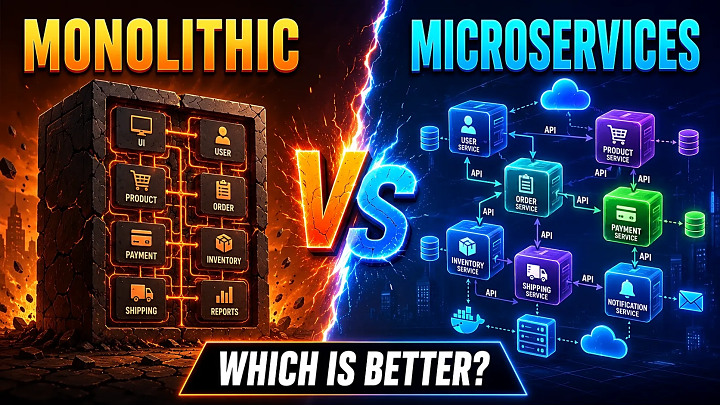
Which architecture can your team build, test, deploy, explain, and maintain successfully?
This guide compares monolithic vs microservices architecture and helps final-year students choose among a traditional monolith, modular monolith, and independent services.
Quick Answer
A monolithic architecture packages the user interface, business logic, and data-access layer into one application that is developed and deployed as one unit.
A microservices architecture divides an application into loosely coupled services organized around business capabilities. Each service can be developed, deployed, and scaled independently, and mature implementations give each service control over its data.
For most small and medium final-year projects, a modular monolith is the strongest default. It preserves simple deployment while enforcing clean boundaries between modules. Choose microservices only when independent scaling, separate release cycles, fault isolation, or distributed-systems learning is a genuine project requirement.
In This Guide
- Architecture definitions
- Detailed comparison
- Performance, data, testing, and security
- Student decision scorecard
- Food-ordering example
- Migration strategy
- FAQs
What Is Monolithic Architecture?
A monolithic application combines its major capabilities in one codebase and one deployable unit. A college ERP, for example, may include authentication, students, attendance, fees, examinations, and reports inside one Django, Laravel, Spring Boot, or Node.js application.
A monolith is not automatically badly designed. It can use domain modules, services, repositories, interfaces, validation, and automated tests. Problems begin when modules access one another’s data directly and every feature depends on every other feature.
Advantages of a Monolith
- One repository and deployment pipeline
- Fast local development and easier onboarding
- Simple end-to-end testing and debugging
- Lower hosting and monitoring overhead
- In-process communication without network latency
- Easier demonstration during project evaluation
Limitations of a Monolith
As the codebase grows, tightly coupled modules can slow development. A small change may require rebuilding and redeploying the complete application. Scaling is also coarse-grained: if reporting consumes most resources, the team may still need to scale the whole application.
What Is Microservices Architecture?
Microservices architecture structures an application as loosely coupled, independently deployable services. Services align with business capabilities such as users, inventory, orders, payments, and notifications. They communicate through REST or gRPC APIs, message brokers, or event streams.
This flexibility introduces distributed-system work. A local function call becomes a network request that can time out, fail partially, or be retried. The team must plan authentication, data ownership, observability, deployment automation, and recovery. AWS similarly identifies cloud architecture, APIs, containerization, infrastructure, and distributed troubleshooting as additional microservices competencies.
Advantages of Microservices
- Independent service deployment
- Targeted scaling for high-demand capabilities
- Clear ownership across teams
- Better isolation of some failures
- Freedom to choose a suitable technology per service
- Incremental replacement of selected capabilities
Limitations of Microservices
- Multiple repositories or complex repository management
- More deployment pipelines and environment configuration
- Network latency and partial failures
- Distributed data-consistency problems
- Harder debugging across service boundaries
- Higher monitoring, security, and hosting overhead
Microservices are an operational model, not merely a monolith split into folders.
Monolithic vs Microservices Architecture: Detailed Comparison
|
Factor |
Monolith / Modular Monolith |
Microservices |
|
Deployment |
One application |
Each service can deploy independently |
|
Communication |
In-process method calls |
APIs, events, or message brokers |
|
Data model |
Usually one database |
Preferably service-owned data |
|
Initial complexity |
Low to moderate |
High |
|
Performance |
Fewer network boundaries |
Serialization and network overhead |
|
Scaling |
Scale the whole application |
Scale selected services |
|
Testing |
Simpler integrated environment |
Contract, integration, and failure testing |
|
Debugging |
One process and log stream |
Central logging and distributed tracing |
|
Security |
Smaller internal attack surface |
More endpoints, identities, and secrets |
|
Hosting cost |
Usually lower |
Often higher due to multiple workloads |
|
Best team fit |
Small, coordinated team |
Mature teams with clear ownership |
|
Student-project fit |
Strong for most projects |
Best for justified advanced projects |
Atlassian similarly identifies simpler deployment, debugging, testing, and centralized performance as common monolith advantages, while independent deployment and scaling are central microservices benefits.
Performance, Data, Testing, and Security
Performance and Communication Overhead
A monolith can call internal modules directly in memory. Microservices communicate across process or network boundaries, adding serialization, connection, authentication, and latency overhead. Independent scaling may improve selected workloads, but distribution does not automatically make an application faster.
Data Consistency
A single relational database can use local ACID transactions across multiple tables. With service-owned databases, one business workflow may update several services. Teams then use patterns such as sagas, compensating actions, idempotent consumers, and transactional outboxes to maintain consistency without one global transaction. Microsoft’s architecture guidance specifically recommends Saga and related compensation patterns for consistency across independent service data stores.
For a student project, this matters in workflows such as:
- Create an order.
- Reserve inventory.
- Confirm payment.
- Assign delivery.
- Send notification.
The design must explain what happens if payment succeeds but inventory reservation fails.
Testing and Observability
A monolith mainly needs unit, integration, and end-to-end testing in one environment. Microservices also require API-contract, message-flow, and failure tests. Troubleshooting distributed requests needs correlation IDs, centralized logs, metrics, health checks, and tracing.
Security
A monolith normally protects one application boundary. Microservices increase the number of APIs, service identities, tokens, secrets, and network policies. A credible design should show controlled entry, service authentication, least privilege, validation, secret management, and rate limiting.
Which Architecture Is Best for a Final-Year Project?
Choose the simplest architecture that satisfies the real requirements.
Choose a Monolith or Modular Monolith When
- The team has one to five members.
- The deadline is one semester.
- Most modules share one relational database.
- Expected traffic is limited.
- Hosting must remain inexpensive.
- The team needs a reliable live demo and simple setup.
- Examiners will evaluate completeness, documentation, and explanation.
Library management, hostel management, payroll, hospital management, college ERP, and local-service systems usually fit this model well.
Choose Microservices When
- Modules have clearly different scaling requirements.
- Separate teams own separate capabilities.
- Independent release cycles are essential.
- Fault isolation is a stated requirement.
- DevOps, containers, messaging, observability, or distributed systems are explicit learning objectives.
- The team can demonstrate failure handling rather than only drawing service boxes.
A logistics platform, marketplace, OTT prototype, or multi-tenant SaaS may justify microservices when boundaries and operational requirements are real.
The Better Middle Ground: Modular Monolith
A modular monolith is one deployable application with explicit domain modules and controlled dependencies. For example, the order module should call an inventory interface rather than update inventory tables directly. This creates cleaner code, clearer UML diagrams, easier testing, and a future path for extracting selected services.
Architecture Decision Scorecard
Score each statement from 1 to 5.
|
Decision Criterion |
Monolith Favoured When |
Microservices Favoured When |
|
Team size |
Small team |
Multiple autonomous teams |
|
Deadline |
Short and fixed |
Long, staged delivery |
|
Deployment skill |
Basic |
Strong DevOps capability |
|
Scaling |
Similar across modules |
Very different by capability |
|
Data |
Highly relational |
Clear service ownership |
|
Failure handling |
Simple rollback |
Partial-failure recovery designed |
|
Hosting budget |
Limited |
Multiple workloads affordable |
|
Learning objective |
Product completion |
Distributed systems |
If most answers fall in the left column, choose a modular monolith. Do not force a microservices result by giving trendy tools extra weight.
Example: Food-Ordering Application
In a modular monolith, customers, restaurants, menus, carts, orders, payments, delivery, and notifications run inside one backend. The modules remain separate in code but use one deployment and usually one database.
In a microservices version, order, payment, restaurant, delivery, and notification services operate independently. The order service may publish an event after confirmation. Other services consume the event and update their own data.
It becomes academically valuable only when the project demonstrates retries, duplicate handling, compensation, logging, and service health—not merely separate folders or ports.
Step-by-Step Architecture Selection Guide
- List business capabilities. Identify users, products, bookings, payments, reports, and notifications.
- Estimate team capacity. Record skills, time, budget, hosting, and testing ability.
- Define module boundaries. Group features by business responsibility, not by CRUD table.
- Map data ownership. Decide which module creates and controls each entity.
- Evaluate scaling needs. Identify capabilities with genuinely different workloads.
- Choose the simplest viable architecture. Start with a modular monolith unless requirements justify distribution.
- Design failure behaviour. Document retries, rollback, compensation, error messages, and logs.
- Match diagrams to implementation. Ensure the report, UML, deployment diagram, folders, database, and viva explanation describe the system actually built.
Migrating from a Monolith Later
Migration should normally be incremental rather than a complete rewrite. The Strangler Fig pattern replaces selected functionality while the old and new systems coexist; AWS describes the progression as transform, coexist, and eliminate.
A student team can demonstrate this by extracting notifications or report generation, routing selected traffic to the new service, and documenting rollback.
Common Mistakes
- Creating one service for every database table
- Sharing one database while claiming complete service autonomy
- Adding Kubernetes, Kafka, or an API gateway without a requirement
- Building a monolith without module boundaries
- Ignoring timeouts, retries, idempotency, and data consistency
- Treating Docker containers as proof of microservices
- Submitting diagrams that do not match the source code
Frequently Asked Questions
Is microservices architecture better than monolithic architecture?
No. Microservices provide independent deployment and scaling, but monoliths reduce initial and operational complexity. The choice depends on requirements and team capability.
Are microservices faster than monoliths?
Not automatically. Monoliths avoid many network calls, while microservices can scale selected workloads independently. Performance depends on workload, design, infrastructure, and implementation.
Are microservices more expensive?
They often require more infrastructure, pipelines, monitoring, and operational effort. For small projects, the extra cost may provide little practical benefit.
Do microservices need separate databases?
Strong service autonomy usually means that each service controls its data. Direct cross-service table access creates coupling.
Is Docker required for microservices?
No. They can run as processes, containers, or serverless functions. Containers simplify packaging but do not define the architecture.
Can microservices run on one server?
Yes, especially for demonstrations, but one server does not remove distributed communication and consistency challenges.
Can a monolith scale horizontally?
Yes. Multiple application instances can run behind a load balancer, supported by caching and database optimization. The limitation is that scaling is less granular.
Which architecture is best for most final-year projects?
A modular monolith is usually the best balance of clean design, manageable development, simple deployment, testing, documentation, and viva readiness.
Conclusion
Monolithic vs microservices architecture is not a contest between old and modern technology. It is a trade-off between simplicity and deployment flexibility.
For most final-year projects, build a modular monolith with clear domain boundaries, controlled dependencies, reliable testing, and accurate diagrams. Choose microservices only when your requirements justify service independence and your team can implement the supporting engineering: APIs, data ownership, failure recovery, security, observability, and deployment automation.
The strongest architecture is not the one with the most services. It is the one your team can implement completely, measure honestly, and explain confidently.
The tone can be shifted toward a more technical software-engineering audience or a simpler BCA/B.Tech audience without changing the SEO architecture.