How to Prepare for Final Year Project Viva: Questions, Answers & Tips
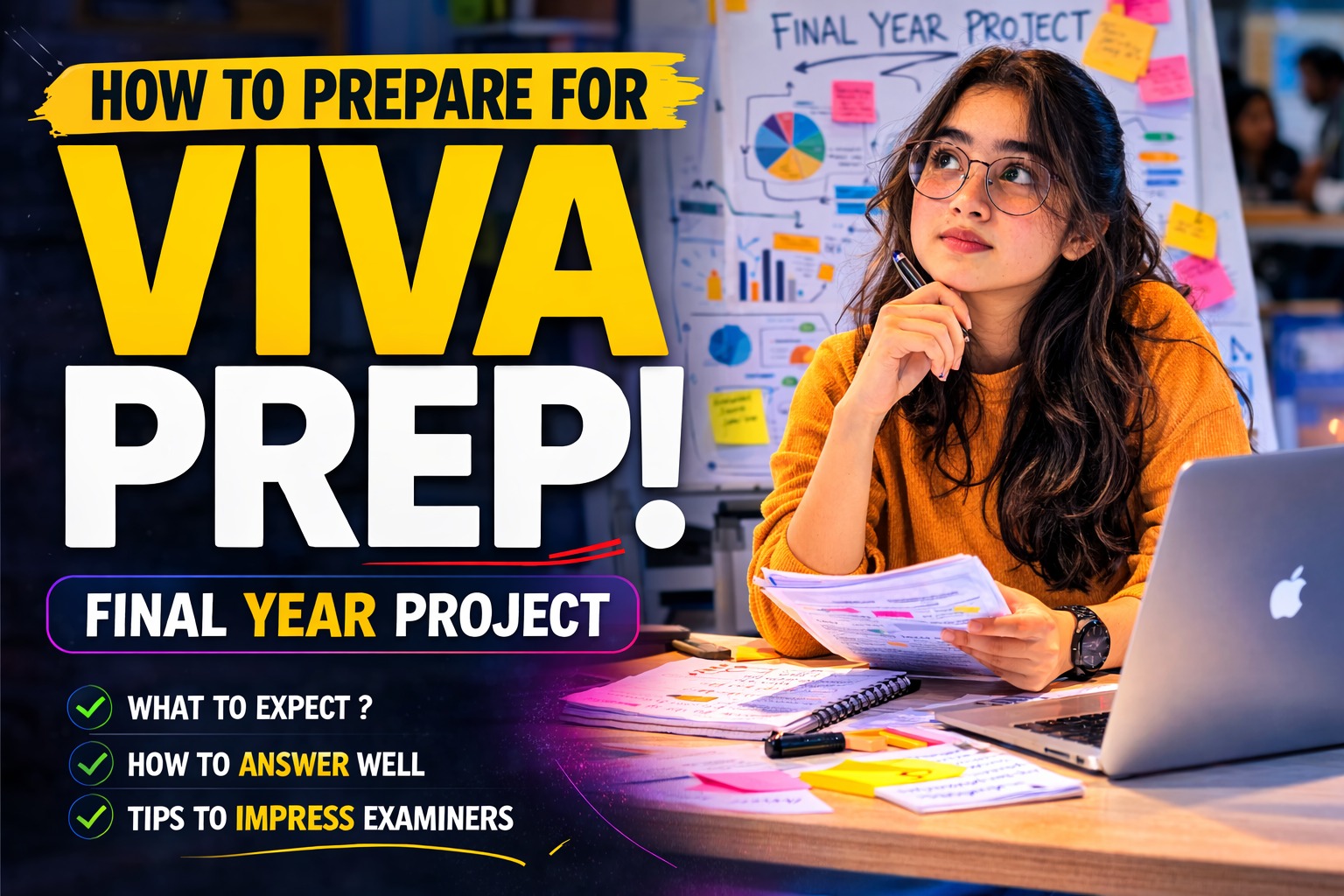
Final year project viva is where many students lose marks they could have protected easily.
Usually, the problem is not the project itself. It is the explanation.
A student may have built decent modules, written code, created diagrams, and even completed testing. But when the examiner asks, “Why did you choose this technology?” or “Explain your ER diagram,” the answer becomes vague, rushed, or memorized.
That is where marks drop.
A good viva is not about sounding like a researcher. It is about proving that you understand your own project clearly, logically, and confidently.
This guide will show you exactly what to revise, what questions are usually asked, how to answer them, and how to walk into your viva better prepared than most students.
Quick Answer
To prepare for your final year project viva, revise your project in this order: problem statement, objective, modules, technology stack, database, diagrams, methodology, testing, results, limitations, and future scope. Then practice the most common project viva questions in simple spoken language. If you can explain your project in 60 seconds, 3 minutes, and 10 minutes, you are already in a strong position.
What Happens in a Final Year Project Viva?
In most final year project viva sessions, the panel wants to check five things:
- Do you understand the real problem your project solves?
- Can you explain how the system works step by step?
- Can you justify your technical choices?
- Can you defend your diagrams, database, testing, and results?
- Can you stay calm and communicate clearly under pressure?
That means viva preparation is not just report revision.
It is explanation training.
What to Revise Before Your Viva
1. Project summary
Prepare a 1-minute introduction covering:
- project title
- problem statement
- target users
- main objective
- key outcome
A strong intro should sound like this:
“Our project is a web-based attendance management system for colleges. It solves the problem of manual attendance tracking. The main users are faculty, students, and admin staff. The objective is to reduce record errors and improve reporting. The final system includes role-based access, attendance entry, report generation, and database-backed storage.”
2. Modules
Know your project modules in workflow order.
For example, a software project may include:
- login/authentication
- dashboard
- user management
- core feature module
- report generation
- admin control panel
Do not just list module names. Explain what each module does.
3. Technology stack
Be ready to explain:
- frontend
- backend
- database
- frameworks
- tools
- APIs or integrations
- deployment method, if applicable
A weak answer says, “We used PHP and MySQL because they are easy.”
A stronger answer says, “We used PHP and MySQL because the project needed a lightweight web stack, fast CRUD development, and structured relational data storage. That combination matched our scope and timeline.”
4. Database design
You should know:
- key tables
- primary keys
- foreign keys
- relationships
- major queries
- how data flows between modules
If your project is database-heavy, expect direct questions here.
5. Diagrams and architecture
Be able to explain:
- ER Diagram
- DFD
- flowchart
- architecture diagram
- UML or use case diagram
Do not point at a diagram and read labels. Start with the big picture, then explain how entities, users, or processes connect.
6. Methodology or SDLC
If your report includes Waterfall, Agile, or SDLC phases, you must justify why that model fits your project.
7. Testing and results
Revise:
- unit testing
- integration testing
- system testing
- sample test cases
- expected vs actual output
- output screens or screenshots
- performance metrics, if relevant
8. Limitations and future scope
This is where maturity shows.
A good limitation answer sounds honest. A good future scope answer sounds realistic.
Most Common Final Year Project Viva Questions
|
Question |
What examiner is testing |
Best answer angle |
|
Tell me about your project |
Clarity |
Problem, users, objective, result |
|
Why did you choose this topic? |
Relevance |
Real need, practical value, suitability |
|
What are your modules? |
System understanding |
Workflow + feature purpose |
|
Why this tech stack? |
Technical judgment |
Simplicity, scalability, cost, familiarity |
|
Explain your ER diagram |
Design understanding |
Entities, relationships, data movement |
|
What is your contribution? |
Ownership |
What you designed, coded, tested, documented |
|
What are the limitations? |
Critical thinking |
Honest current constraints |
|
What is future scope? |
Product thinking |
Practical next improvements |
|
How did you test the system? |
Validation |
Test types, cases, outputs |
|
What result did you achieve? |
Outcome focus |
Efficiency, accuracy, usability, automation |
A Simple Answer Framework That Works
Use this structure for most answers:
Problem → Decision → Implementation → Result → Improvement
Example:
“Our project solves the problem of manual library operations. We chose a web-based system because multiple users need centralized access. The implementation includes admin, student, and issue-return modules with a MySQL database. It reduces manual effort and improves record accuracy. In future, we can add barcode scanning and analytics.”
This works because it sounds natural, shows ownership, and keeps you from rambling.
How to Explain Your Project in 60 Seconds, 3 Minutes, and 10 Minutes
60 seconds
Use for the opening question.
Cover:
- what the project is
- what problem it solves
- who uses it
- what the result is
3 minutes
Use when the panel asks for more.
Add:
- modules
- tech stack
- database
- major workflow
10 minutes
Use for formal explanation or PPT/demo.
Add:
- methodology
- diagrams
- implementation logic
- testing
- results
- limitations
- future scope
Weak Answer vs Strong Answer
|
Situation |
Weak Answer |
Strong Answer |
|
Why this topic? |
“It is an interesting topic.” |
“We chose it because the manual process was slow, error-prone, and relevant to real college workflows.” |
|
Why this tech stack? |
“Because it is easy.” |
“Because it supported fast development, relational storage, and matched our deployment scope.” |
|
What is your contribution? |
“We all worked on everything.” |
“I designed the database schema, implemented authentication, and prepared testing and documentation.” |
|
What are the limitations? |
“No limitations.” |
“The current version is not deployed at scale and does not include advanced analytics or multi-campus support.” |
How to Handle Technical Questions Without Panicking
If you do not know an answer fully, do not bluff.
Use this approach:
- acknowledge the question
- answer the part you know
- connect it to your project
- state the limitation honestly
Example:
“I did not implement that feature directly, but the related concept appears in our authentication module, where session handling controls user access.”
That is far better than guessing.
How to Defend Your Contribution in a Team Project
One of the most common examiner doubts is ownership.
Be ready to answer:
- which module you worked on
- what you coded
- what you documented
- what you tested
- what technical decisions you made
A good contribution statement is specific:
“I handled the database design, login module, and report generation logic. I also prepared the ER diagram, test cases, and part of the implementation chapter.”
Project Demo and Presentation Checklist
Before viva day, keep these ready:
- working local copy
- PPT
- screenshots of major outputs
- sample login credentials
- database backup
- internet backup if hosted
- PDF copy of report
- diagrams in one folder
If your demo fails but your explanation stays strong, you can still recover marks.
If your demo fails and you panic, the panel may doubt the whole project.
7-Day Final Year Project Viva Preparation Plan
Day 1
Read your full report from start to finish.
Day 2
Write short answers for 20 likely viva questions.
Day 3
Revise ER diagram, DFD, flowchart, architecture, and database schema.
Day 4
Revise implementation flow, modules, APIs, testing, and outputs.
Day 5
Practice PPT and project demo.
Day 6
Take a mock viva with follow-up interruptions.
Day 7
Polish delivery, confidence, posture, and timing.
Final Viva Checklist
Before your viva, make sure you can answer these clearly:
- What problem does your project solve?
- Who are the users?
- What are the main modules?
- Why did you choose this technology?
- How does data move through the system?
- What are the important tables and relationships?
- How did you test the project?
- What result did you achieve?
- What are the limitations?
- What is the future scope?
- What exactly was your contribution?
FAQs
1. How many questions are usually asked in a final year project viva?
It varies, but most students face a short sequence of project-specific, technical, and follow-up questions.
2. What is the most common final year project viva question?
Usually, “Tell me about your project” or “Why did you choose this topic?”
3. Do I need to memorize the entire report?
No. You need to understand the important sections deeply enough to explain them naturally.
4. Are diagrams important in project viva?
Yes. ER diagrams, DFDs, UML, flowcharts, and architecture diagrams are common discussion points.
5. How do I answer if I do not know something?
Stay calm, answer what you know, connect it to your project, and avoid bluffing.
6. Can I score well even if my project is simple?
Yes. Clarity, confidence, and ownership often matter more than complexity alone.
7. What should I revise one day before viva?
Project summary, modules, database, diagrams, testing, result, limitations, and future scope.
8. What documents should I carry for project viva?
Your report, PPT, screenshots, credentials, diagrams, and demo backup.
Conclusion
Preparing for a final year project viva is less about cramming and more about structured understanding.
When you know your project’s objective, modules, tech stack, database, diagrams, testing, contribution, and limitations, your answers become sharper automatically.
A good viva is not a memory test.
It is proof that you understand what you built, why you built it, and how it works.
Students who prepare from complete documentation usually perform better because they can revise faster and answer with more confidence. FileMakr’s homepage, project-report collections, final year project ideas page, and source-code hub are all relevant next steps for students who need stronger reports, diagrams, ready-to-run code, or project examples.