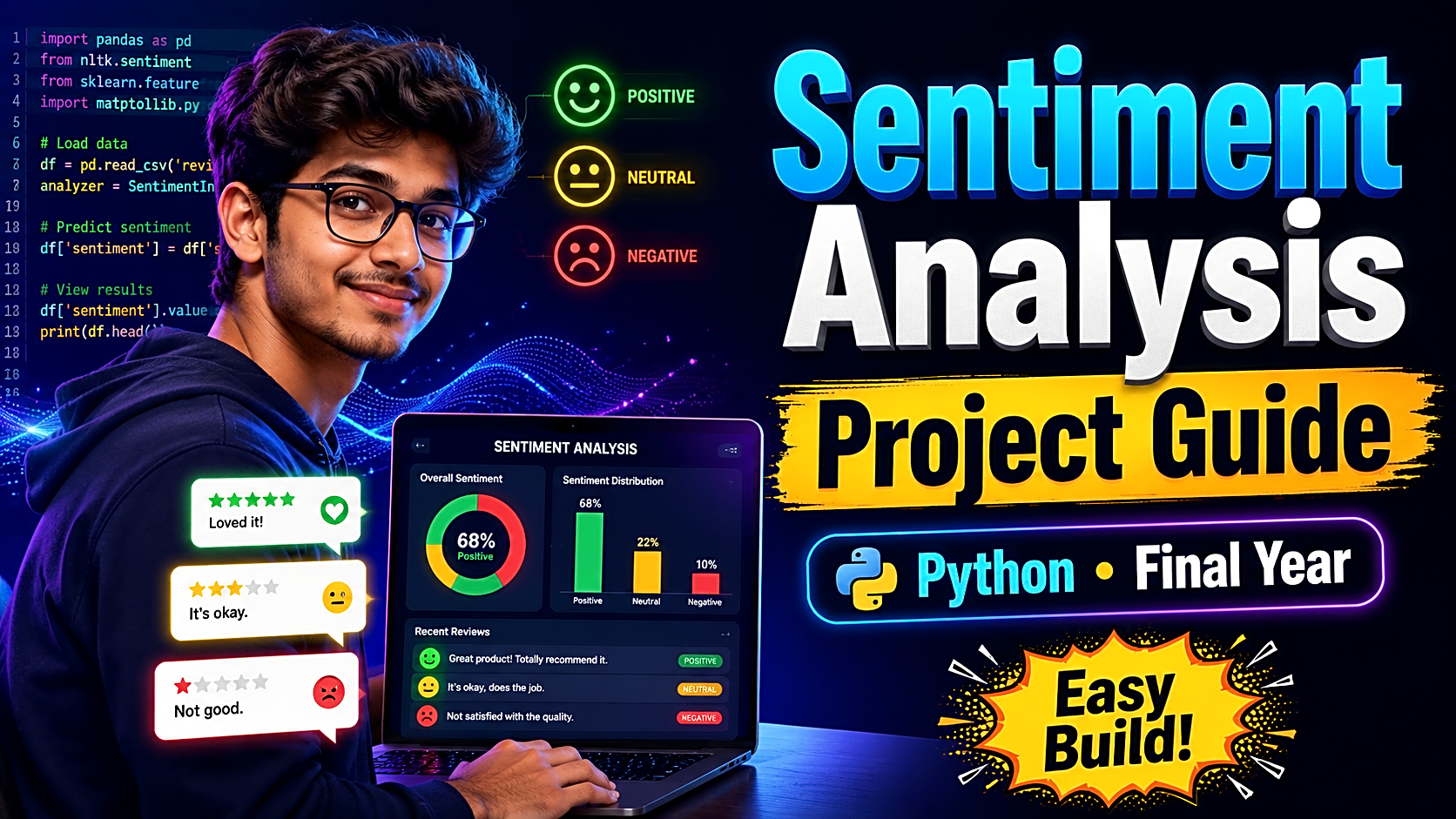
Sentiment Analysis Project Guide Using Python for Final Year Students
A sentiment analysis project is a machine learning and natural language processing project that classifies text as positive, negative, or neutral. For final year students, it is one of the best project topics because it combines Python, NLP, dataset handling, model training, evaluation, web development, report writing, and viva explanation in one practical system.
Quick Answer: What Is a Sentiment Analysis Project?
A sentiment analysis project analyzes text data such as reviews, comments, tweets, feedback, or survey responses and predicts the sentiment behind the text. A typical final year project uses Python, Scikit-learn, NLTK, Pandas, TF-IDF, Logistic Regression or Naive Bayes, Flask, and a labelled dataset.
In simple terms, the system takes an input like:
|
Input Text |
Predicted Sentiment |
|
“The product quality is excellent.” |
Positive |
|
“The app crashes again and again.” |
Negative |
|
“The delivery arrived today.” |
Neutral |
Sentiment analysis is commonly used to analyze digital text and identify emotional tone such as positive, negative, or neutral. Businesses use it for customer reviews, support messages, social media comments, and feedback analysis.
Table of Contents
- Why Sentiment Analysis Is a Good Final Year Project
- Project Objective
- System Architecture
- Tools and Technologies
- Dataset Sources
- Best Algorithms
- Project Folder Structure
- Sample Python Code
- Implementation Steps
- Report, PPT, Screenshots, and Viva
- FAQs
Why Sentiment Analysis Is a Good Final Year Project
A sentiment analysis final year project is practical, easy to demonstrate, and strong enough for academic submission. It shows that you understand both theory and implementation.
This project is suitable for:
- B.Tech / BE computer science students
- BCA and MCA students
- BSc IT and MSc IT students
- Data science and machine learning beginners
- Students looking for a Python project with source code
It also solves a real-world problem. Companies receive thousands of reviews and comments. Reading them manually is slow, inconsistent, and difficult. Sentiment analysis automates the process and helps identify whether people are satisfied, unhappy, or neutral.
Main Objective of a Sentiment Analysis Project
The main objective is to build a system that accepts text input and predicts sentiment accurately.
A good project should include:
- Dataset collection
- Text cleaning
- NLP preprocessing
- Feature extraction
- Model training
- Sentiment prediction
- Accuracy evaluation
- Flask-based web interface
- Admin/user module
- Project report and PPT
For a stronger submission, you can build a sentiment analysis project with source code, report, PPT, and live demo.
Sentiment Analysis Project Architecture
A basic architecture includes five layers:
|
Layer |
Purpose |
|
User Interface |
User enters review/comment |
|
Backend |
Flask/Django handles requests |
|
NLP Processing |
Cleans and prepares text |
|
ML Model |
Predicts sentiment |
|
Database |
Stores users, reviews, predictions |
Workflow
- User enters text in the web form.
- Backend receives the input.
- Text is cleaned and converted into features.
- ML model predicts sentiment.
- Output is displayed as positive, negative, or neutral.
- Prediction history is saved in the database.
This architecture is easy to explain during viva and can also be represented in your project report as a system flow diagram.
Tools and Technologies Used
|
Component |
Recommended Tool |
Purpose |
|
Programming Language |
Python |
ML and NLP development |
|
Data Handling |
Pandas, NumPy |
Dataset processing |
|
NLP |
NLTK, spaCy, TextBlob |
Tokenization, stop words, preprocessing |
|
ML Library |
Scikit-learn |
Model training and evaluation |
|
Feature Extraction |
TF-IDF, CountVectorizer |
Convert text into numbers |
|
Algorithms |
Naive Bayes, Logistic Regression, SVM |
Sentiment classification |
|
Backend |
Flask |
Web application |
|
Database |
SQLite / MySQL |
Store users and predictions |
|
Frontend |
HTML, CSS, Bootstrap |
Student-friendly UI |
|
Advanced Option |
Hugging Face / BERT |
Deep learning sentiment analysis |
Scikit-learn provides machine learning tools for predictive data analysis, while NLTK provides tools for building Python programs that work with human language data.
Dataset Sources for Sentiment Analysis Project
A labelled dataset is required because the model learns from examples.
|
Dataset Type |
Best For |
Difficulty |
|
IMDb movie reviews |
Binary positive/negative sentiment |
Beginner |
|
Amazon product reviews |
Product review analysis |
Beginner–Intermediate |
|
Twitter/X tweets |
Social media sentiment |
Intermediate |
|
Hotel reviews |
Travel/hospitality sentiment |
Beginner |
|
Student feedback |
College feedback analysis |
Beginner |
|
Custom survey data |
Unique academic project |
Intermediate |
Recommended dataset columns:
|
Review |
Sentiment |
|
“The service was excellent.” |
Positive |
|
“The product stopped working.” |
Negative |
|
“The delivery arrived today.” |
Neutral |
For final year submission, choose a dataset that is easy to explain. Product reviews and student feedback are usually better than complex social media datasets because tweets may contain slang, sarcasm, emojis, and mixed language.
Best Algorithms for Sentiment Analysis
|
Algorithm |
Best For |
Pros |
Limitations |
|
Naive Bayes |
Beginner projects |
Fast, simple, good for text |
Less accurate on complex data |
|
Logistic Regression |
Balanced projects |
Accurate, explainable |
Needs good preprocessing |
|
SVM |
Higher accuracy |
Works well with TF-IDF |
Slower on large datasets |
|
LSTM |
Deep learning project |
Handles sequence patterns |
Needs more data and training |
|
BERT |
Advanced NLP project |
Strong contextual understanding |
Harder to explain and deploy |
For most students, TF-IDF + Logistic Regression is the best combination because it is accurate, lightweight, and easy to explain in viva. Use BERT only if you are comfortable explaining transformer models.
Project Folder Structure
Use a clean structure like this:
sentiment-analysis-project/
│
├── app.py
├── model/
│ ├── sentiment_model.pkl
│ └── vectorizer.pkl
│
├── dataset/
│ └── reviews.csv
│
├── templates/
│ ├── index.html
│ ├── login.html
│ └── dashboard.html
│
├── static/
│ ├── css/
│ └── images/
│
├── notebook/
│ └── model_training.ipynb
│
├── database/
│ └── sentiment.db
│
└── requirements.txt
This folder structure helps examiners understand that your project is not only a notebook but a complete web-based application.
Sample Python Code for Sentiment Analysis
import pandas as pd
from sklearn.model_selection import train_test_split
from sklearn.feature_extraction.text import TfidfVectorizer
from sklearn.linear_model import LogisticRegression
from sklearn.metrics import accuracy_score, classification_report
import pickle
# Load dataset
data = pd.read_csv("dataset/reviews.csv")
X = data["review"]
y = data["sentiment"]
# Convert text into numerical features
vectorizer = TfidfVectorizer(stop_words="english", max_features=5000)
X_vectorized = vectorizer.fit_transform(X)
# Train-test split
X_train, X_test, y_train, y_test = train_test_split(
X_vectorized, y, test_size=0.2, random_state=42
)
# Train model
model = LogisticRegression()
model.fit(X_train, y_train)
# Evaluate model
y_pred = model.predict(X_test)
print("Accuracy:", accuracy_score(y_test, y_pred))
print(classification_report(y_test, y_pred))
# Save model and vectorizer
pickle.dump(model, open("model/sentiment_model.pkl", "wb"))
pickle.dump(vectorizer, open("model/vectorizer.pkl", "wb"))
This code trains a basic machine learning sentiment analysis model using TF-IDF and Logistic Regression.
How to Make a Sentiment Analysis Project in Python
Step 1: Select the Problem Statement
Choose a specific use case:
- Product review sentiment analysis
- Movie review sentiment analysis
- Student feedback sentiment analysis
- Hotel review sentiment analysis
- Food delivery review sentiment analysis
- Twitter sentiment analysis
Example problem statement:
“Design and develop a sentiment analysis system using Python and machine learning to classify customer reviews as positive, negative, or neutral.”
Step 2: Collect the Dataset
Use a labelled dataset with text and sentiment labels. Check for duplicate values, missing values, class imbalance, and noisy text.
Step 3: Clean the Text
Remove:
- Punctuation
- HTML tags
- URLs
- Extra spaces
- Special characters
- Stop words
- Duplicate rows
Convert all text to lowercase for consistency.
Step 4: Apply NLP Preprocessing
Common preprocessing techniques include tokenization, stemming, lemmatization, and stop word removal. NLTK tokenizers divide strings into smaller word or punctuation units, which is useful for text processing.
Step 5: Convert Text into Features
Machine learning algorithms cannot directly understand text. Use:
- CountVectorizer
- TF-IDF Vectorizer
TF-IDF is generally better for student projects because it gives higher importance to meaningful words and reduces the impact of very common words.
Step 6: Train the Model
Split your data into 80% training and 20% testing. Train Naive Bayes, Logistic Regression, or SVM.
Step 7: Evaluate Performance
Use:
- Accuracy
- Precision
- Recall
- F1-score
- Confusion matrix
Do not rely only on accuracy. If your dataset has more positive reviews than negative reviews, accuracy may look good even when the model performs poorly on minority classes.
Step 8: Build the Flask Web App
Create a simple web interface where users can enter a review and get instant sentiment output.
Recommended pages:
- Home page
- Login/register page
- Prediction page
- User history page
- Admin dashboard
- Accuracy report page
Step 9: Add Database Support
Use SQLite or MySQL to store:
- User details
- Submitted reviews
- Predicted sentiment
- Prediction date/time
- Admin uploaded datasets
Step 10: Prepare Final Submission
Your final project should include source code, report, PPT, screenshots, dataset, model file, database file, and setup instructions.
Screenshots to Include in Your Project
Add these screenshots to your report and PPT:
|
Screenshot |
Why It Matters |
|
Home page |
Shows project UI |
|
Login page |
Shows user module |
|
Prediction form |
Shows main functionality |
|
Sentiment result page |
Shows output |
|
Admin dashboard |
Shows management module |
|
Accuracy report |
Shows ML evaluation |
|
Confusion matrix |
Shows technical depth |
|
Database table |
Shows backend storage |
Use descriptive image alt text when publishing this article, such as:
- sentiment analysis project architecture using python
- sentiment analysis project output screenshot
- python sentiment analysis flask web app
- sentiment analysis confusion matrix example
Project Report Format
|
Chapter |
Content |
|
Abstract |
Short summary of the project |
|
Introduction |
Background and importance |
|
Existing System |
Manual review analysis problems |
|
Proposed System |
ML-based sentiment prediction |
|
Objectives |
Main goals of the project |
|
Literature Review |
Related NLP and ML work |
|
System Requirements |
Hardware/software requirements |
|
System Design |
Architecture, DFD, ER diagram |
|
Implementation |
Python, Flask, model training |
|
Testing |
Test cases and screenshots |
|
Results |
Accuracy, confusion matrix |
|
Conclusion |
Summary of project |
|
Future Scope |
BERT, multilingual support, dashboard |
PPT Outline for Sentiment Analysis Project
Your PPT can include:
- Title slide
- Problem statement
- Objective
- Existing system
- Proposed system
- System architecture
- Dataset details
- Algorithm used
- Modules
- Screenshots
- Results and accuracy
- Future scope
- Conclusion
Viva Questions and Answers
|
Viva Question |
Short Answer |
|
What is sentiment analysis? |
It is an NLP technique used to classify text as positive, negative, or neutral. |
|
Which algorithm did you use? |
Logistic Regression with TF-IDF because it is accurate and easy to explain. |
|
Why is preprocessing needed? |
It removes noise and improves model performance. |
|
What is TF-IDF? |
It converts text into numerical features based on word importance. |
|
What is a confusion matrix? |
It shows correct and incorrect predictions for each class. |
|
Why Flask? |
Flask is lightweight and suitable for creating simple ML web apps. |
|
What is the limitation of your project? |
It may struggle with sarcasm, mixed language, and biased datasets. |
Limitations of Sentiment Analysis
Sentiment analysis is useful but not perfect. It may fail when text includes sarcasm, slang, emojis, Hinglish, mixed emotions, or domain-specific words.
Example:
“Great, the app crashed again.”
A human understands this as negative, but a basic model may treat “great” as positive. Mentioning limitations improves trust and shows technical maturity.
Future Scope
The project can be improved with:
- Hindi or Hinglish sentiment analysis
- Real-time Twitter/X sentiment monitoring
- Aspect-based sentiment analysis
- Deep learning with LSTM
- Transformer models like BERT
- Dashboard with charts
- API integration
- Admin analytics panel
- Multilingual sentiment detection
FAQs
1. What is a sentiment analysis project?
A sentiment analysis project is an NLP and machine learning project that classifies text as positive, negative, or neutral based on the opinion expressed in the text.
2. How to make a sentiment analysis project in Python?
Collect a labelled dataset, clean the text, apply NLP preprocessing, convert text using TF-IDF, train a model using Scikit-learn, evaluate accuracy, and build a Flask web app.
3. Which algorithm is best for sentiment analysis project?
For final year students, Logistic Regression with TF-IDF is often the best option because it is accurate, simple, and easy to explain.
4. Can I build a sentiment analysis project with source code?
Yes. A complete project should include Python source code, dataset, trained model, Flask app, report, PPT, screenshots, and setup instructions.
5. What dataset is used for sentiment analysis?
Common datasets include IMDb movie reviews, Amazon product reviews, Kaggle review datasets, hotel reviews, restaurant reviews, tweets, and student feedback datasets.
6. Is sentiment analysis a good final year project?
Yes. It is practical, industry-relevant, and demonstrates machine learning, NLP, Python, data preprocessing, model evaluation, and web development skills.
7. What should I include in the project report?
Include abstract, introduction, objectives, existing system, proposed system, system architecture, dataset, algorithm, implementation, testing, screenshots, conclusion, and future scope.
8. Can FileMakr help with a sentiment analysis project?
Yes. FileMakr can provide support for final year projects with source code, report, PPT, setup guidance, and custom machine learning project requirements.
Conclusion
A sentiment analysis project using Python is a strong final year project because it is practical, easy to demonstrate, and connected to real-world applications like customer review analysis, social media monitoring, product feedback, and student feedback systems.
To make your project stronger, include a clean dataset, proper preprocessing, TF-IDF vectorization, Logistic Regression or SVM, accuracy evaluation, Flask web interface, database support, screenshots, report, PPT, and viva preparation.
Need a ready sentiment analysis project with source code, report, PPT, and setup support? Explore FileMakr’s final year project source code or contact the team for a custom machine learning project.