How to Choose the Best Final Year Project
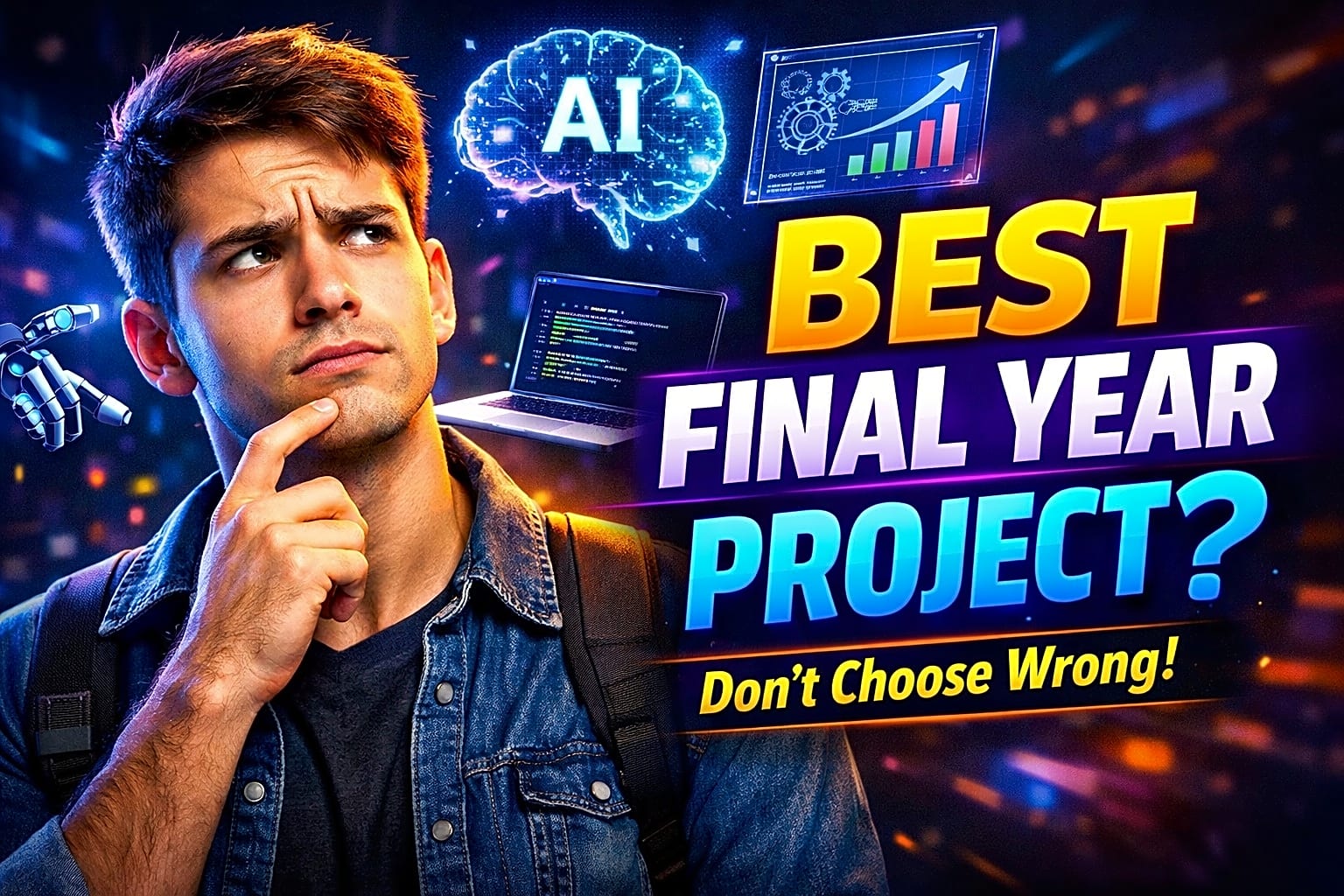
Choosing a final year project is not about picking the most advanced topic. It is about choosing a topic you can build, explain, document, and defend within your deadline.
Quick Answer
The best final year project is one that matches your skills, fits your semester timeline, solves a clear problem, and supports your placement goals. A good project should also be easy to explain during viva, realistic to complete in 4 to 6 modules, and strong enough to turn into a resume bullet, GitHub project, or interview talking point.
If you have not shortlisted a topic yet, start by exploring final year project ideas before using the framework below.
Why Your Final Year Project Choice Matters
Your project affects more than just internal marks. It can influence:
- your viva confidence
- your report quality
- your interview discussions
- your internship or placement profile
- your practical skill development
That matters even more in a skills-first hiring market. Google’s people-first content guidance also emphasizes substance, usefulness, and real value over surface-level optimization, which is the same principle students should apply to project choice: choose a topic that has depth, not just trend appeal.
Recent employability reporting in India also points to rising demand for practical, job-ready skills, with the India Skills Report 2026 noting stronger emphasis on employability and digital capability.
What Makes a Final Year Project “Best”?
A final year project is “best” when it checks five boxes:
1. It matches your current skill level
A strong topic should stretch you a little, not overwhelm you. If you cannot explain the tech stack, architecture, dataset, workflow, or outputs, the topic becomes risky during implementation and viva.
2. It supports your career goal
Choose a project that aligns with the role you want.
- Web developer: CRM, admin dashboard, e-commerce, booking system
- Data/AI role: recommendation engine, prediction model, sentiment analysis
- Mobile developer: attendance app, service-booking app, utility app
- Cybersecurity role: authentication system, intrusion detection, log analysis
- General placements: management systems, dashboards, workflow automation
3. It is feasible in one semester
A moderate project completed properly is better than a half-built advanced system.
4. It solves a real problem
Projects with a clear use case are easier to present, justify, and discuss in interviews.
5. It is easy to demonstrate
Simple demo flow matters. A project that shows login, dashboard, action, output, and report is usually easier to explain than a highly abstract idea.
The Final Year Project Scorecard
Use this scorecard before you finalize any topic.
|
Criteria |
What to Check |
Score /5 |
|
Skill match |
Can you build and explain most of it yourself? |
|
|
Career relevance |
Does it help with your target job role? |
|
|
Scope control |
Can it be completed in 4–6 modules? |
|
|
Viva readiness |
Can you explain problem, logic, testing, and limitations? |
|
|
Resource feasibility |
Do you have the dataset, API, hardware, and budget? |
|
|
Documentation fit |
Can you write synopsis, diagrams, report, and future scope? |
|
|
Guide approval |
Does it fit your department rubric and expectations? |
Interpretation
- 28–35: strong topic
- 21–27: workable with tighter scope
- Below 21: high-risk topic, reconsider
How to Know If a Topic Is Too Broad
A topic is too broad if:
- it depends on too many features
- it needs expensive hardware
- it requires large datasets you do not have
- it relies on multiple third-party APIs
- it sounds impressive but has no clear module structure
- you cannot describe the final deliverables in one minute
A simple rule: if your project idea cannot be broken into 4 to 6 clear modules, the scope is probably too wide.
Example
Weak topic: “Smart AI-based complete college automation system”
Better topic: “Student leave management system with role-based dashboard and analytics”
The second version has a clear problem statement, better scope definition, and easier documentation.
How to Check Originality Before Finalizing
Your project does not need to be a world-first invention. It does need to show original understanding.
Check originality like this:
- Search whether the topic is overused in your department.
- Change the use case, feature set, workflow, or audience.
- Add one differentiator:
- analytics dashboard
- automation
- recommendation feature
- role-based access
- reporting module
- Make sure you can explain why your version is different.
A copied topic with memorized answers is a viva risk. A familiar topic with thoughtful execution is safer and often scores better.
How to Estimate Scope in 4 to 6 Modules
A well-scoped final year project usually includes:
- User/authentication module
- Core data entry or transaction module
- Processing/business logic module
- Dashboard or output module
- Reports/testing/documentation module
- Optional advanced feature such as notifications, analytics, or AI
This helps with feasibility analysis, implementation timeline, and report writing.
Which Project Type Should You Choose?
Web or management system projects
Best for:
- beginners
- BCA students
- placement-focused students
- fast completion
Examples:
- library management system
- inventory dashboard
- job portal
- complaint management system
AI or machine learning projects
Best for:
- MCA or CSE students targeting data roles
- students comfortable with Python, datasets, and model evaluation
Examples:
- fake news detection
- student performance prediction
- recommendation system
- sentiment analysis dashboard
Mobile app projects
Best for:
- Android-focused students
- students targeting mobile development roles
Examples:
- attendance tracker
- service booking app
- bus tracking app
- campus utility app
IoT or hardware-based projects
Best for:
- innovation-focused teams
- students with actual hardware access and testing time
Examples:
- smart monitoring system
- IoT attendance device
- energy tracking system
These can score well, but they carry more hardware and testing risk.
Best Final Year Project by Student Profile
For beginners
Choose topics with simple workflows and predictable outputs:
- attendance system
- expense tracker
- online quiz system
- task manager
- library management system
These are ideal if you are also exploring easy final year projects for beginners.
For placements
Choose projects that show product thinking and business workflow:
- CRM
- e-commerce platform
- inventory dashboard
- learning portal
- customer support ticket system
These often create stronger discussion points in interviews and pair well with final year project source code examples.
For B.Tech, BCA, and MCA students
- B.Tech / CSE / IT: web apps, AI tools, dashboard systems, cybersecurity tools
- BCA: management systems, admin panels, portals, mobile utility apps
- MCA: full-stack systems, data-driven apps, enterprise workflows, recommendation tools
3 Worked Topic Evaluation Examples
Example 1: Library Management System
- Skill match: high
- Resource need: low
- Viva ease: high
- Placement value: medium
Best for: beginners, BCA students, fast completion
Verdict: strong safe topic if you add role-based access, reports, or analytics
Example 2: CRM Dashboard
- Skill match: medium
- Resource need: medium
- Viva ease: high
- Placement value: high
Best for: placement-focused students
Verdict: excellent if your goal is software or web development interviews
Example 3: Fake News Detection
- Skill match: medium to high
- Resource need: high
- Viva ease: medium
- Placement value: high for AI roles
Best for: students already comfortable with Python, NLP, datasets, model metrics
Verdict: strong but risky if you do not understand preprocessing, training, and evaluation
What to Discuss With Your Project Guide Before Finalizing
Before you freeze your topic, ask your guide:
- Is the scope realistic for one semester?
- Does it fit the department rubric?
- Is implementation required, or is research depth more important?
- What documentation format is expected?
- Are diagrams, testing, synopsis, or IEEE format mandatory?
- What will matter most in viva: innovation, usability, technical depth, or report quality?
This one conversation can save weeks of rework.
Common Mistakes to Avoid
- choosing a trending topic without understanding it
- selecting a topic with no real use case
- ignoring resource constraints like datasets, APIs, or hardware
- copying a senior’s project blindly
- keeping the scope too broad
- choosing teammates based only on friendship
- depending on one member for all coding
- delaying documentation until the end
Expert Tips for Better Marks, Viva, and Placements
- Choose a topic you can explain in simple language.
- Keep one modern feature, but do not let it dominate the whole project.
- Prefer clear inputs, processing, outputs, and reports.
- Build something that can become a GitHub portfolio project.
- Make report writing easy by choosing a topic with clear modules and deliverables.
- A stable, fully working project usually beats a flashy but unfinished one.
FAQ
How do I choose the best final year project?
Choose a project based on skill match, career relevance, scope, resources, and viva readiness. Then validate it with your guide before finalizing.
Which final year project is best for placements?
Projects with practical workflows such as CRM, dashboards, e-commerce, management systems, and useful AI tools usually perform best for placements.
How do I know if my final year project is too advanced?
It is too advanced if you cannot explain the architecture, dependencies, and outputs clearly, or if it depends on too many unknown tools, APIs, or datasets.
How original should a final year project be?
It should show original thinking in implementation, feature selection, workflow, or use case. It does not need to be completely unique globally.
Which final year project is best for beginners?
Management systems, portals, dashboards, and simple utility apps are usually best for beginners because they are easier to build, document, and defend.
What should I discuss with my project guide before finalizing?
Discuss scope, modules, timeline, rubric fit, documentation requirements, implementation expectations, and viva criteria.
Conclusion
The best final year project is not the fanciest topic. It is the one that fits your skills, solves a clear problem, matches your career direction, and can be completed confidently within your deadline.
Before you finalize any idea, ask:
- Can I build this realistically?
- Can I explain it clearly in viva?
- Will it help my marks, resume, or placements?
If the answer is yes, you have probably found the right topic.
Next step
Still undecided? Explore final year project ideas, compare options by stream, and shortlist 3 topics before moving to source code or report preparation