Introduction
Most final year projects end the same way: submission, viva, marks, ZIP file, forgotten folder.
But your project does not have to stop there.
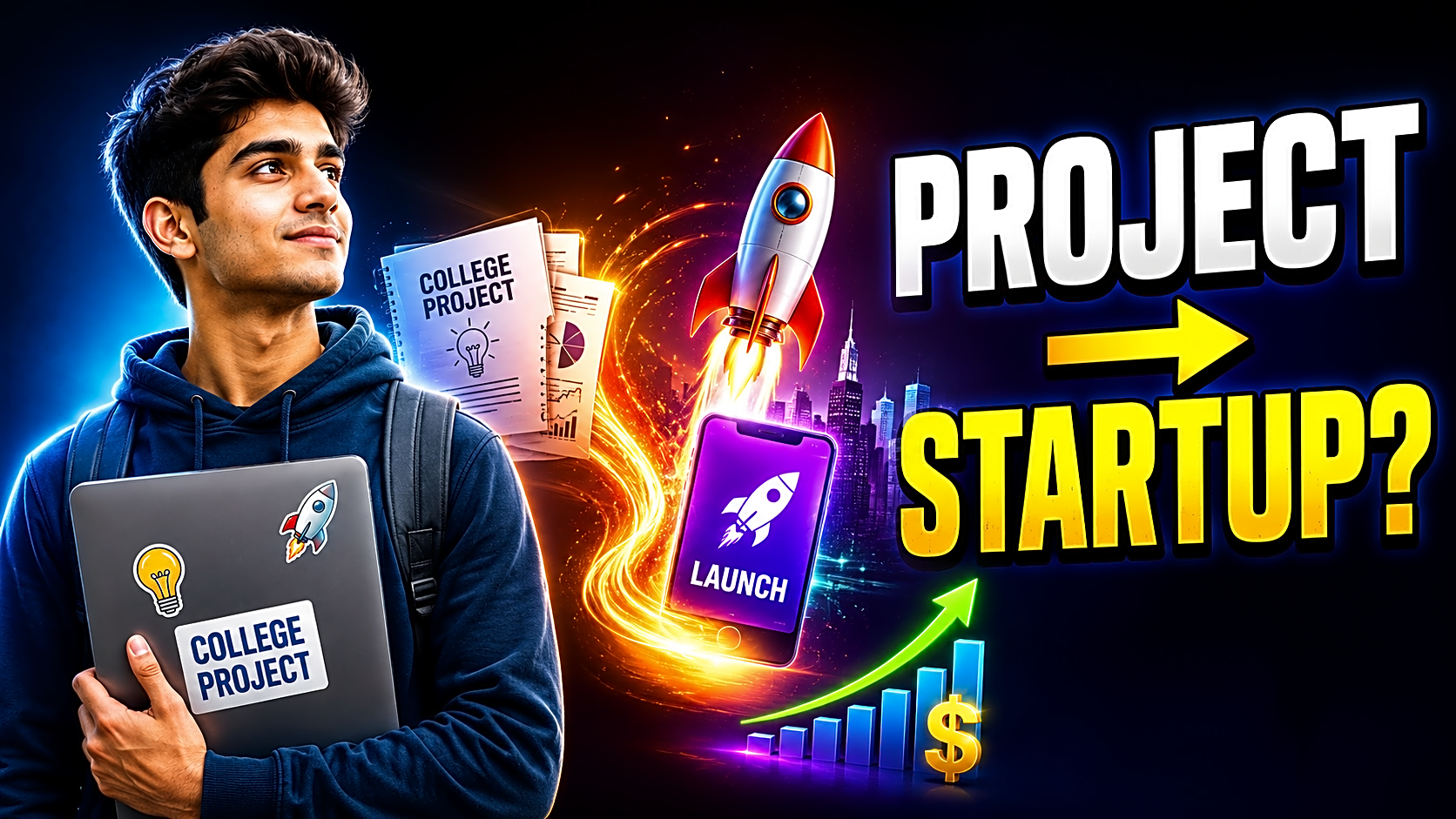
A college project can become your first startup, freelance product, portfolio proof, GitHub showcase, or pitch competition idea. The difference is not just better coding. The real difference is whether your project solves a real problem for real users.
A “Hospital Management System” is only a project when it is made for submission. It becomes a startup opportunity when a small clinic can actually use it to manage appointments, patients, and reports. A “PG Finder” is only a project when it runs on localhost. It becomes a product when students and PG owners can use it online.
India’s startup ecosystem is growing fast, and student founders now have more access to college incubation cells, entrepreneurship clubs, hackathons, startup grants, GitHub, LinkedIn, and online launch platforms than before.
This guide explains how to turn your college project into a startup step by step.
Quick Answer: Can a College Project Become a Startup?
Yes, a college project can become a startup if it solves a real problem, has a clear target user, works beyond classroom demonstration, and can be improved into a minimum viable product.
Start with this simple path:
- Identify the real problem.
- Choose one specific target user group.
- Convert the project into an MVP.
- Test it with real users.
- Improve the product based on feedback.
- Build a simple business model.
- Launch a demo version.
- Prepare a pitch deck.
- Use college incubation or startup support.
- Keep improving until users find it useful.
College Project vs Startup: What Is the Real Difference?
|
Factor |
College Project |
Startup Version |
|
Main goal |
Marks and viva |
Real users and value |
|
Audience |
Faculty and examiner |
Customers and users |
|
Testing |
Demo testing |
Real user feedback |
|
Features |
Academic modules |
Problem-solving workflow |
|
Hosting |
Localhost often enough |
Online demo needed |
|
Documentation |
Project report |
Pitch deck, roadmap, user guide |
|
Business model |
Not required |
Required |
|
Success metric |
Submission accepted |
Users adopt it |
A project proves that you can build. A startup proves that your solution is useful.
How to Know If Your College Project Is Startup-Worthy
Not every college project should become a startup. Some projects are good for learning only. Some are strong enough to become a product.
Your project has startup potential if it meets these conditions:
- It solves one clear problem.
- A specific user group needs it.
- The current solution is slow, manual, costly, or confusing.
- Users can understand the product without your explanation.
- The project can work online, not only on localhost.
- There is a possible way to earn from it.
- Users are willing to test it or give feedback.
For example:
|
College Project |
Startup Version |
First Target User |
Possible Revenue Model |
|
Hostel Management System |
PG owner SaaS dashboard |
PG owners |
Monthly subscription |
|
Clinic Appointment System |
Local clinic booking tool |
Small clinics |
Monthly fee |
|
Food Ordering System |
Campus canteen preorder app |
College canteen |
Commission per order |
|
Complaint Management System |
College or society helpdesk |
Colleges, hostels, societies |
Setup fee plus support |
|
Resume Builder |
Student portfolio and resume tool |
Final year students |
Freemium model |
Step-by-Step Guide to Turn Your Project into a Startup
Step 1: Write a Real Problem Statement
Avoid describing only the technology.
Weak statement:
“We made an online food ordering website.”
Better statement:
“College canteens face long queues during lunch hours, so our system allows students to place orders in advance and helps canteen staff manage order status faster.”
A good problem statement should answer:
- Who has the problem?
- What exactly is difficult for them?
- How are they solving it today?
- Why is the current method inefficient?
- How does your project improve the situation?
Step 2: Choose One Target User Group
A startup cannot start by serving everyone.
Choose one niche first.
Examples:
- School ERP project: small private schools
- PG finder project: students shifting to new cities
- Inventory project: local shop owners
- Appointment system: small clinics
- Expense tracker: students and freelancers
- Complaint system: colleges or housing societies
A narrow audience helps you build better features, write clearer content, and find your first users faster.
Step 3: Convert the Project into an MVP
MVP means minimum viable product. It is the simplest working version that solves the main problem.
Do not add every feature at once.
If your project is a clinic appointment system, your MVP may include:
- Patient registration
- Doctor profile
- Appointment booking
- Admin approval
- Appointment status
- Basic dashboard
- Simple confirmation message
Advanced features like AI recommendation, payment gateway, mobile app, and analytics can come later.
MVP Readiness Checklist
|
MVP Check |
Status |
|
Solves one clear problem |
Yes or No |
|
Has one target user group |
Yes or No |
|
Works without developer explanation |
Yes or No |
|
Has secure login |
Yes or No |
|
Has clean dashboard |
Yes or No |
|
Has hosted demo |
Yes or No |
|
Has feedback form |
Yes or No |
|
Tested by at least 5 real users |
Yes or No |
|
Has possible pricing model |
Yes or No |
If you cannot mark at least six items as “Yes,” your project needs improvement before you pitch it as a startup.
Step 4: Improve Technical Quality
Many final year projects work only for demo day. A startup-ready product must be more stable.
Improve these areas:
- Clean folder structure
- Proper database relationships
- Secure login and password hashing
- Input validation
- Mobile-friendly UI
- Error handling
- Admin dashboard
- Backup and export option
- README file
- Setup guide
- Hosted demo link
If your project needs stronger modules or a better technical base, you can connect this section with final year project source code support from FileMakr.
Step 5: Validate with Real Users
Before thinking about funding, test your project with real people.
Do not ask only friends. Friends usually say, “Good project.” Real users show you what is missing.
Ask 5 to 20 users these questions:
- What problem do you face currently?
- How do you solve it today?
- How much time or money does the current method take?
- What part of this product is useful?
- What confused you?
- Which feature did you ignore?
- Would you use this weekly?
- Would you pay for it?
- What would stop you from using it?
- What should be improved first?
This process is called customer discovery. It helps you avoid building features nobody needs.
Step 6: Build a Simple Business Model
A startup needs a way to survive.
You do not need a complex financial model at the beginning. Start with a simple earning logic.
|
Project Type |
Possible Business Model |
|
School ERP |
Monthly subscription per school |
|
Clinic booking system |
Monthly fee per clinic |
|
Food ordering system |
Commission per order |
|
PG finder |
Paid listing for PG owners |
|
Resume builder |
Freemium model |
|
E-learning platform |
Course commission |
|
Inventory system |
One-time setup plus support |
|
Complaint system |
Setup fee plus maintenance |
Choose pricing based on user affordability. A small shop may prefer one-time setup. A school may accept monthly subscription.
Step 7: Understand Startup India and Registration Basics
You do not need to register a company on day one.
First validate the problem, test your MVP, and confirm that users care about the solution. Registration becomes important when you start earning, applying for formal grants, signing contracts, raising funds, or building with co-founders.
For India, student founders should understand:
- Startup India recognition
- DPIIT recognition
- Company or LLP registration
- Founder ownership
- IP documentation
- Co-founder agreement
- Basic tax and compliance needs
This is educational guidance, not legal or financial advice. For registration, taxation, or equity decisions, take professional advice.
Step 8: Use College Resources
Your college can become your first testing ground.
Look for:
- Entrepreneurship Cell
- Incubation center
- Innovation club
- Hackathons
- Faculty mentors
- Startup competitions
- Prototype grants
- Industry talks
- Alumni founders
A college can help you find pilot users, mentors, feedback, and early credibility.
Step 9: Create a Pitch Deck
A pitch deck is a short presentation that explains your startup idea clearly.
Use this format:
- Problem
- Target users
- Current solution gap
- Your product
- Product screenshots
- MVP status
- User feedback or traction
- Business model
- Competitor comparison
- Roadmap
- Team
- Support or funding needed
Your pitch should not sound like a project report. It should show why the problem matters, who needs the solution, and how your product can grow.
If you already have a project report, you can convert it into a startup pitch deck by reusing the problem statement, methodology, diagrams, modules, screenshots, and testing results.
Step 10: Launch a Demo Version
Your project should be visible online.
You can launch through:
- GitHub repository
- Hosted web app
- Landing page
- Demo video
- LinkedIn post
- Google Form waitlist
- Portfolio page
For students, a clean GitHub repository with screenshots, database setup, README, and demo video can create strong placement and startup credibility.
You can also link this section to a guide on how to publish your project on GitHub or how to build a developer portfolio.
Common Mistakes Students Make
Building Without Validation
Do not add features before confirming whether users need them.
Treating Startup as Only an App
A startup is more than software. It includes users, support, pricing, onboarding, marketing, and feedback.
Copying Generic Project Ideas
A copied project may pass submission, but it rarely becomes a startup. Add a real use case, niche audience, or improved workflow.
Ignoring UI and UX
If users cannot understand your product in two minutes, they will not use it.
Not Hosting the Project
A localhost project is difficult to share. A hosted demo builds trust.
No Clear Revenue Model
Even if you start free, know who may pay later and why.
Final Launch Checklist
Before presenting your project as a startup, check:
- Problem statement is clear
- Target user is specific
- MVP is working
- Demo is hosted
- GitHub or documentation is clean
- Real users have tested it
- Feedback has been recorded
- Business model is simple
- Pitch deck is ready
- Screenshots and demo video are available
- Team roles are documented
- Next roadmap is clear
How FileMakr Can Help
If you are a final year student and want to improve your project before turning it into a startup idea, FileMakr can support you with ready-to-run source code, project reports, live demos, setup guidance, diagrams, documentation, and presentation material.
You can use FileMakr resources for final year project ideas, final year project source code, B.Tech final year project reports, project demo preparation, and documentation support.
FAQ
Can I turn my final year project into a startup?
Yes. If your final year project solves a real problem and can be used by real users, it can become the starting point of a startup.
Which college projects are best for startups?
Projects in education, healthcare, finance, agriculture, local services, logistics, AI tools, automation, and business management often have strong startup potential.
Do I need funding to start?
No. In the beginning, validation, users, feedback, and a working MVP are more important than funding.
Do I need to register a company immediately?
Not always. First validate your idea. Registration becomes important when you start earning, signing contracts, raising funds, or applying to formal startup programs.
How do I validate my college project idea?
Talk to real users, observe their current process, test your MVP, collect feedback, and check whether they would use or pay for the product.
Can a PHP or MERN project become a startup?
Yes. Technology stack matters less than problem-solving. A simple PHP, MERN, Python, Django, or Java project can become valuable if it solves a real problem.
What should I include in a college project startup pitch deck?
Include problem, target users, solution, screenshots, MVP status, user feedback, business model, competitor comparison, team, roadmap, and support needed.
Is a project report useful for startup conversion?
Yes. Your project report can help explain the problem, methodology, system design, modules, testing, results, and future scope. It can be converted into a pitch deck and product roadmap.
Conclusion
Turning your college project into a startup is not about making the biggest app. It is about solving one real problem better than the existing method.
Start small. Validate the problem. Build an MVP. Test it with users. Improve the product. Create a simple business model. Launch a demo. Use your college ecosystem.
Your final year project can become more than a submission file. With the right execution, it can become your first product, your strongest portfolio proof, or your first startup.