: How to Manage Time for a Final Year Project
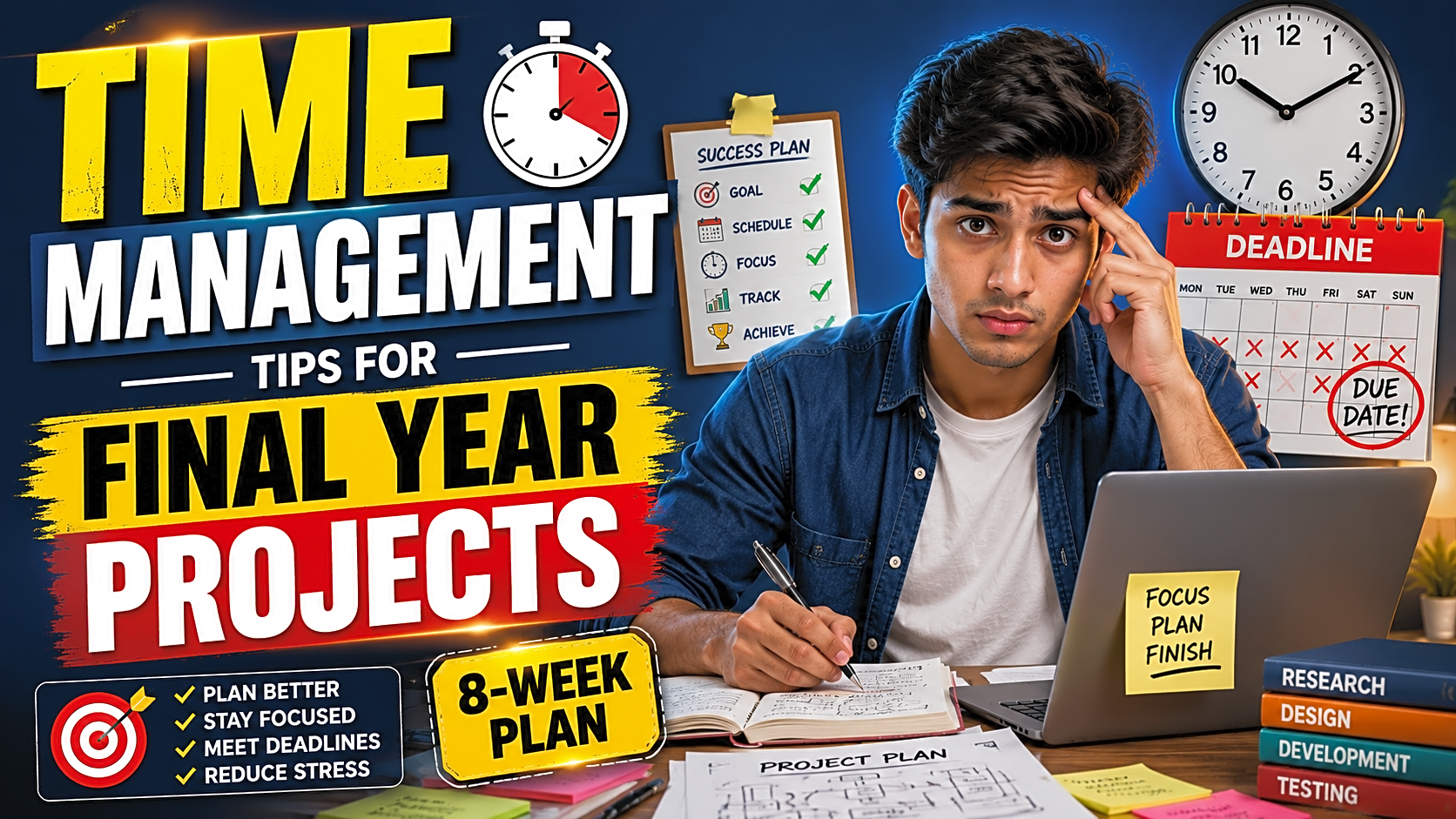
The best way to manage time for a final year project is to divide the complete work into weekly milestones. Start with topic selection and synopsis, then move to requirement analysis, design, coding, testing, documentation, PPT, and viva preparation. Maintain a project tracker, take guide feedback early, and keep at least 20–25% buffer time for bugs, formatting, screenshots, corrections, and printing.
What Is Time Management in a Final Year Project?
Time management in a final year project means planning every deliverable before the deadline arrives. It includes deciding what to complete, when to complete it, who is responsible, and how much buffer time is needed.
A proper plan should cover:
- Topic selection
- Synopsis or proposal
- Requirement analysis
- Module planning
- ER diagram, DFD, UML, and database design
- Frontend, backend, and database development
- Testing and bug fixing
- Screenshots and output results
- Project report writing
- PPT and viva preparation
- Guide review and corrections
The goal is simple: complete the basic working project first, then improve design, features, documentation, and presentation.
Main Final Year Project Deliverables and Time Allocation
|
Project Component |
What It Includes |
Suggested Time |
|
Topic selection |
Domain, technology, scope |
5% |
|
Synopsis |
Objective, scope, methodology |
10% |
|
Requirement analysis |
Users, modules, features |
10% |
|
Design phase |
ER diagram, DFD, UML, database |
15% |
|
Development |
Frontend, backend, database, modules |
30% |
|
Testing |
Test cases, bug fixing, screenshots |
10% |
|
Documentation |
Report chapters, formatting, references |
15% |
|
PPT and viva |
Slides, demo script, Q&A |
5% |
Most students spend too much time choosing a topic and too little time on testing, documentation, and viva. That is the biggest mistake.
8-Week Final Year Project Timeline
If you have around two months, follow this practical timeline.
|
Week |
Main Goal |
What to Complete |
|
Week 1 |
Topic finalization |
Select topic, define scope, discuss with guide |
|
Week 2 |
Synopsis and planning |
Prepare synopsis, modules, timeline, objectives |
|
Week 3 |
Design phase |
ER diagram, DFD, UML, database schema |
|
Week 4 |
Development phase 1 |
Login, dashboard, database connection, basic CRUD |
|
Week 5 |
Development phase 2 |
Core modules, user/admin features, validations |
|
Week 6 |
Testing and improvement |
Fix bugs, test forms, capture screenshots |
|
Week 7 |
Documentation |
Complete report chapters, diagrams, test cases |
|
Week 8 |
PPT and viva |
Prepare slides, demo flow, viva questions |
This timeline works well for web development projects, management systems, Python projects, PHP/MySQL projects, MERN projects, and many B.Tech, BCA, MCA, and diploma submissions.
30-Day Emergency Plan for Late Starters
If only one month is left, do not panic. Reduce the scope and focus on core deliverables.
|
Days |
Focus Area |
What to Complete |
|
Day 1–3 |
Topic and scope freeze |
Finalize topic, modules, technology, database |
|
Day 4–8 |
Core development |
Login, dashboard, CRUD, database connection |
|
Day 9–14 |
Main features |
Complete project-specific modules |
|
Day 15–18 |
Testing |
Fix bugs, validate forms, prepare screenshots |
|
Day 19–24 |
Report writing |
Add chapters, diagrams, test cases, outputs |
|
Day 25–27 |
PPT and viva |
Prepare slides, demo flow, Q&A |
|
Day 28–30 |
Final review |
Guide corrections, formatting, PDF, print/binding |
In a 30-day plan, avoid unnecessary features. A simple working project with a clean report is better than a complex incomplete project.
Use a Gantt Chart for Final Year Project Planning
A Gantt chart helps you see your full project timeline visually. You can create it in Google Sheets, Excel, Notion, Trello, or any project management tool.
Your Gantt chart should include:
- Task name
- Start date
- End date
- Status
- Assigned person
- Dependency
- Remarks
Example:
|
Task |
Week 1 |
Week 2 |
Week 3 |
Week 4 |
Week 5 |
Week 6 |
Week 7 |
Week 8 |
|
Topic approval |
✓ |
|||||||
|
Synopsis |
✓ |
|||||||
|
ER/DFD/UML |
✓ |
|||||||
|
Coding |
✓ |
✓ |
||||||
|
Testing |
✓ |
|||||||
|
Report |
✓ |
✓ |
||||||
|
PPT and viva |
✓ |
This simple visual plan helps you explain progress to your guide and avoid hidden delays.
Break the Project Into Small Tasks
Never write “complete project” in your task list. That is too vague.
For example, if your topic is Online Examination System, break it into smaller tasks:
- Create login page
- Add student registration
- Create admin dashboard
- Add question management
- Create exam page
- Add timer
- Store answers in database
- Generate result
- Test login and exam flow
- Capture output screenshots
- Add test cases in report
- Prepare viva questions
Small tasks are easier to complete, track, and assign in group projects.
Best Tools to Track Final Year Project Progress
|
Tool |
Best For |
Student Use Case |
|
Google Sheets |
Simple tracker |
Task list, deadline, status |
|
Trello |
Kanban workflow |
To-do, in progress, completed |
|
Notion |
Notes + planning |
Synopsis, modules, report notes |
|
GitHub |
Code backup |
Version control and team coding |
|
Google Drive |
File storage |
Report, PPT, screenshots, PDFs |
|
Excel |
Gantt chart |
Weekly project planning |
For most students, Google Sheets plus Google Drive is enough. If you are working in a group, Trello or Notion can make coordination easier.
Group Project Time Management Plan
Group projects fail when everyone assumes someone else is working.
Use this role matrix:
|
Role |
Responsibility |
|
Project lead |
Timeline, guide communication, final integration |
|
Developer 1 |
Login, dashboard, database connection |
|
Developer 2 |
Core modules and validations |
|
Documentation lead |
Report chapters, diagrams, formatting |
|
Testing lead |
Test cases, screenshots, bug list |
|
Presentation lead |
PPT, demo script, viva questions |
Even in a group, every student should understand the full project. In viva, the evaluator may ask anyone about modules, database, logic, and future scope.
Keep Documentation Parallel With Coding
Do not wait until coding is complete to start the report. Documentation usually takes longer than expected.
Follow this workflow:
- After topic approval, write introduction and objectives
- After module planning, write scope and requirements
- After database design, add ER diagram and table structure
- After development, add implementation details and screenshots
- After testing, add test cases and results
- Before submission, format the report and prepare the final PDF
This saves time and keeps your report accurate.
Take Guide Feedback Early
Do not show your project only at the end. Take feedback at each milestone:
- Topic approval
- Synopsis approval
- Module list approval
- Diagram approval
- Development review
- Report draft review
- Final demo review
Early feedback prevents last-minute rework. If your guide asks for changes near the deadline, use your buffer time only for corrections, not for building the entire project.
Final Submission Checklist
Before final submission, check:
- Source code is working
- Database file is included
- Setup steps are clear
- Project report is formatted
- ER diagram, DFD, and UML diagrams are added
- Screenshots are updated
- Test cases are included
- PPT is ready
- Viva questions are prepared
- Soft copy and print copy are ready
- Backup is saved on Google Drive or GitHub
Students who need help with ready-to-run source code, report formatting, diagrams, PPT, demo preparation, or viva support can explore FileMakr’s final year project resources and guides.
Common Mistakes Students Should Avoid
1. Starting Too Late
Waiting for the guide to ask for updates is risky. Start planning as soon as the topic is discussed.
2. Choosing an Overly Complex Topic
A project should be impressive but achievable. Do not choose a topic you cannot build, explain, or document.
3. Ignoring Testing
A project that fails during demo creates a poor impression. Test every module before presentation.
4. Writing the Report at the Last Moment
A weak report can reduce marks even if the project works. Documentation is part of the evaluation.
5. No Backup
Always keep backup copies of code, database, report, screenshots, and PPT.
FAQ: Time Management Tips for Final Year Projects
1. How do I manage time for my final year project?
Divide the project into weekly milestones, maintain a task tracker, take guide feedback early, and keep buffer time for testing, documentation, and corrections.
2. What is the best timeline for a final year project?
An 8-week timeline is practical for most students. If the deadline is closer, use a 30-day emergency plan and reduce extra features.
3. How many hours should I spend daily?
Spend 1–2 focused hours daily. During coding, testing, and submission week, increase it to 2–4 hours if needed.
4. How can I complete my final year project fast?
Freeze the scope, complete the core modules first, avoid unnecessary features, write documentation parallel with coding, and prepare screenshots early.
5. How do I make a Gantt chart for a final year project?
List all major tasks, assign start and end dates, mark dependencies, and update progress weekly using Google Sheets, Excel, Trello, or Notion.
6. How do I manage a group final year project?
Assign clear roles, use a shared tracker, store files in one common folder, and hold weekly progress reviews.
7. What if my guide asks for corrections at the last moment?
Prioritize mandatory corrections first. Avoid adding new features unless required. Use your buffer week for formatting, report changes, and demo fixes.
8. How should I prepare for viva?
Prepare answers for objective, scope, technology stack, database, modules, methodology, testing, limitations, and future enhancement. Practice the demo at least three times.
Conclusion
Time management is the difference between a stressful final year project and a confident final submission.
The best approach is to start early, divide the project into milestones, track progress weekly, keep documentation parallel with coding, take guide feedback on time, and prepare your PPT and viva before the final deadline.
A successful final year project is not only about coding. It is about planning, execution, documentation, testing, presentation, and confidence.