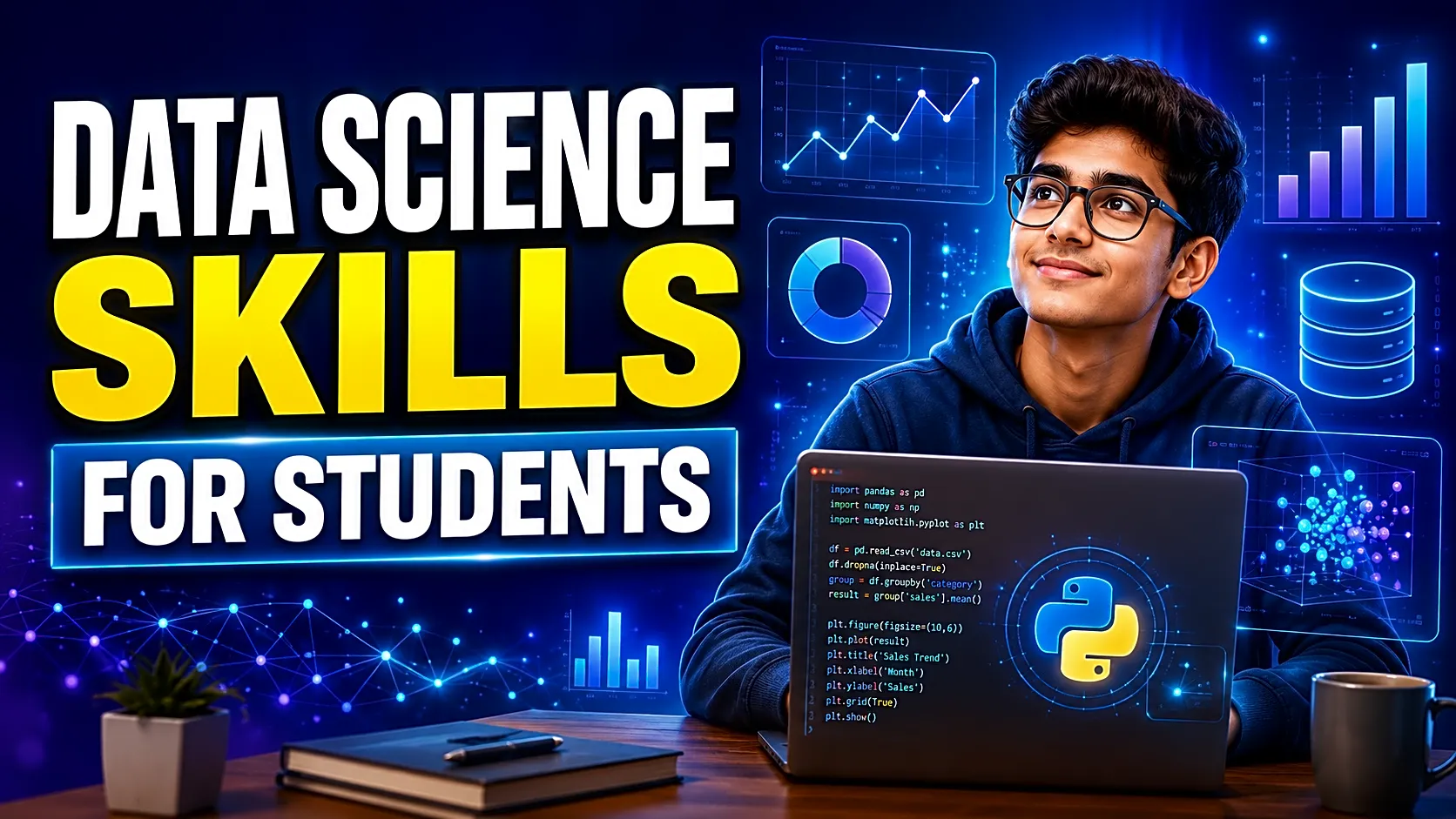
What Data Science Skills Should Students Learn?
Students should learn these data science skills in this order:
- Python programming
- Excel and SQL
- Statistics and probability
- Data cleaning and preprocessing
- Exploratory Data Analysis
- Data visualization
- Machine learning basics
- Feature engineering and model evaluation
- Git, GitHub and portfolio building
- Communication, reporting and data storytelling
After these foundations, students can move toward deep learning, natural language processing, cloud basics, model deployment and AI-assisted workflows.
What Is Data Science?
Data science is the process of collecting, cleaning, analyzing, visualizing and modeling data to solve real-world problems. It combines programming, statistics, business understanding and machine learning.
For example, a data science project may predict student performance, detect fake news, recommend products, analyze sales, identify fraud, or forecast crop yield.
A good student project should not only show model accuracy. It should explain the problem, dataset, preprocessing steps, algorithm, result, limitations and future scope.
Why Data Science Skills Matter for Students in 2026
Data-driven decision-making is now used in healthcare, education, finance, e-commerce, agriculture, marketing and software products. The World Economic Forum has reported that AI, big data and cybersecurity are expected to grow quickly as skill areas, while analytical thinking, leadership, collaboration and resilience remain important human skills.
That means students need a balanced skill set. Technical skills help you build the solution. Communication skills help you explain why the solution matters.
For Indian final-year students, data science skills are useful because they help with:
- Academic projects and major/minor submissions
- Internship and fresher resume building
- GitHub and LinkedIn portfolio creation
- Viva, PPT and project report preparation
- Entry-level roles such as data analyst, ML intern, BI analyst and junior data scientist
Core Data Science Skills Every Student Should Learn
1. Python Programming
Python is usually the best starting point because it is simple, readable and widely used in analytics, automation, machine learning and AI projects.
Students should learn:
- Variables, loops, functions and conditions
- Lists, dictionaries, tuples and sets
- File handling
- Error handling
- Basic object-oriented programming
- Writing clean and readable code
For data science, Python becomes powerful when combined with libraries such as Pandas, NumPy, Matplotlib, Seaborn, Plotly and Scikit-learn.
2. SQL and Database Skills
SQL is essential because real-world data is usually stored in databases. Even if your final output is a machine learning model, you may still need to fetch, filter, join and summarize data.
Learn:
- SELECT, WHERE and ORDER BY
- GROUP BY and aggregate functions
- JOIN operations
- Subqueries
- MySQL, PostgreSQL or SQLite
- Basic database design
SQL is especially useful in projects with admin panels, user dashboards, prediction history, reports or login systems.
3. Statistics and Probability
Statistics helps you understand data instead of blindly running algorithms. Without statistics, students may build models but fail to explain why the model works.
Focus on:
- Mean, median and mode
- Variance and standard deviation
- Correlation and covariance
- Probability distributions
- Sampling
- Hypothesis testing
- Regression basics
- Outliers
You do not need advanced mathematics at the beginning. Start with basic concepts and apply them to real datasets.
4. Data Cleaning and Preprocessing
Raw data is rarely perfect. It may contain missing values, duplicate rows, spelling differences, wrong formats and outliers.
Students should learn how to:
- Handle missing values
- Remove duplicates
- Convert data types
- Rename and format columns
- Detect outliers
- Encode categorical values
- Scale numerical values
- Merge datasets
This is one of the most important data science skills because poor data quality leads to poor results.
5. Exploratory Data Analysis
Exploratory Data Analysis, or EDA, means understanding the dataset before building a model.
During EDA, you answer questions like:
- What columns are available?
- Which values are missing?
- Which features affect the target variable?
- Are there patterns, trends or unusual values?
- Which visualizations explain the data clearly?
For example, in a student performance prediction project, EDA can show whether attendance, study hours, previous marks or assignment scores affect final results.
6. Data Visualization and Storytelling
Data visualization helps you explain insights clearly. A good chart can make your project easier to understand during viva or presentation.
Learn:
- Bar charts
- Line charts
- Histograms
- Scatter plots
- Box plots
- Heatmaps
- Dashboards
Tools include Excel, Power BI, Tableau, Matplotlib, Seaborn and Plotly.
But remember: do not add random charts. Every chart should answer a question.
7. Machine Learning Basics
Machine learning should come after Python, SQL, statistics and data preprocessing.
Start with:
- Linear Regression
- Logistic Regression
- Decision Tree
- Random Forest
- K-Nearest Neighbors
- Naive Bayes
- K-Means Clustering
- Support Vector Machine
Also learn model evaluation:
- Accuracy
- Precision
- Recall
- F1-score
- Confusion matrix
- RMSE
- Train-test split
- Cross-validation
For final-year projects, you should be able to explain why you selected an algorithm and what limitations it has.
8. Feature Engineering and Model Improvement
Feature engineering means improving the input data so the model can learn better patterns. This includes creating new columns, selecting useful features, removing noisy data and transforming variables.
For example, in a sales prediction project, raw date data can be converted into month, season, weekday or festival-period features.
This skill separates a copied project from a properly understood project.
9. GitHub and Portfolio Building
A student who knows how to present work professionally has a major advantage.
Your GitHub project should include:
- Project title
- Problem statement
- Dataset source
- Tools and technologies used
- Features/modules
- Screenshots
- Model accuracy or results
- Installation steps
- Conclusion
- Future scope
A clean README file can make your project easier to evaluate by teachers, recruiters and interviewers.
Data Science Roadmap for Students: 30/60/90/180 Days
|
Timeline |
Focus Area |
Skills to Learn |
Output |
|
First 30 days |
Foundations |
Python, Excel, SQL basics |
Small analysis tasks |
|
60 days |
Data handling |
Pandas, NumPy, cleaning, EDA |
Complete EDA notebook |
|
90 days |
Machine learning |
Regression, classification, evaluation |
Beginner ML project |
|
180 days |
Portfolio |
GitHub, dashboard, deployment, report |
3–5 portfolio projects |
This roadmap is realistic for students because it focuses on output, not only theory.
Data Science Skills by Career Role
|
Role |
Must-Have Skills |
Optional Skills |
|
Data Analyst |
Excel, SQL, statistics, Power BI, data visualization |
Python, Tableau |
|
Junior Data Scientist |
Python, SQL, EDA, ML, statistics |
Deep learning, cloud |
|
ML Intern |
Python, Scikit-learn, preprocessing, model evaluation |
TensorFlow, deployment |
|
BI Analyst |
SQL, dashboards, reporting, business metrics |
Python automation |
If your goal is an internship, focus first on Python, SQL, EDA, visualization and 2–3 strong portfolio projects.
Best Data Science Projects for Final-Year Students
|
Project Idea |
Difficulty |
Skills Used |
Best For |
|
Student Performance Prediction |
Beginner |
Python, EDA, ML |
Academic project |
|
Sales Dashboard |
Beginner |
Excel, SQL, Power BI |
Data analyst portfolio |
|
Disease Prediction System |
Intermediate |
ML, preprocessing, Flask/Streamlit |
Healthcare ML project |
|
Fake News Detection |
Intermediate |
NLP, ML, text preprocessing |
AI/ML project |
|
Customer Churn Prediction |
Intermediate |
Classification, EDA, business analysis |
Internship portfolio |
|
Credit Card Fraud Detection |
Advanced |
Classification, imbalance handling |
Advanced ML portfolio |
|
Recommendation System |
Advanced |
Similarity, ranking, user behavior |
E-commerce project |
Choose a project you can explain confidently. A simple project with strong documentation is better than an advanced project you do not understand.
Implementation Guide: How to Learn Data Science Step by Step
Step 1: Learn Python Basics
Practice small programs daily. Do not jump directly into machine learning.
Step 2: Learn Excel and SQL
Understand how data is stored, filtered, grouped and summarized.
Step 3: Start Pandas and NumPy
Use Pandas to read CSV files, clean data, filter rows and create summaries.
Step 4: Practice EDA on Real Datasets
Use datasets from Kaggle, UCI Machine Learning Repository, government data portals or college survey data.
Step 5: Build Visualizations
Create charts that answer real questions. Add observations below every chart.
Step 6: Learn Basic Machine Learning
Start with regression and classification. Focus on understanding the workflow, not memorizing algorithms.
Step 7: Build One Complete Project
A complete student project should include dataset upload, preprocessing, prediction, result display, dashboard, database, report, screenshots and conclusion.
Step 8: Upload to GitHub
Add README, screenshots, setup instructions and project explanation.
Step 9: Prepare for Viva and Interviews
Be ready to explain your dataset, algorithm, modules, accuracy, limitations and future scope.
Common Mistakes Students Should Avoid
Many students fail to build real data science skills because they follow the wrong sequence.
Avoid these mistakes:
- Learning machine learning before Python basics
- Ignoring statistics
- Copying code without understanding it
- Using too many tools at once
- Building only notebook-based projects with no UI or report
- Not documenting the project properly
- Ignoring GitHub
- Focusing only on accuracy
- Not preparing viva questions
- Using AI tools without verifying outputs
AI tools can help with explanation, debugging and documentation, but they should not replace your own understanding.
Final-Year Project Checklist
Before submission, check whether your project includes:
- Clear problem statement
- Dataset description
- Data cleaning steps
- EDA charts
- ML algorithm explanation
- Model evaluation
- Frontend or dashboard
- Database if required
- Screenshots
- Report and PPT
- Testing section
- Future scope
- GitHub repository
- Viva preparation
This checklist makes your project more complete and easier to present.
FAQs on Data Science Skills for Students
1. What are the most important data science skills for students?
The most important skills are Python, SQL, statistics, data cleaning, EDA, visualization, machine learning basics, GitHub, communication and project-building.
2. Is Python enough for data science?
No. Python is important, but students also need SQL, statistics, data preprocessing, visualization, machine learning and problem-solving skills.
3. How long does it take students to learn data science?
A student can learn the basics in 3 months and build a strong portfolio in 6 months with consistent practice.
4. Which data science skill should beginners learn first?
Beginners should start with Python, Excel and SQL before moving to Pandas, NumPy, statistics and machine learning.
5. What are the best data science projects for final-year students?
Good projects include student performance prediction, disease prediction, fake news detection, customer churn prediction, sales dashboard, fraud detection and recommendation systems.
6. Do students need maths for data science?
Yes, but beginners can start with basic statistics, probability, algebra and logical thinking. Advanced roles require deeper mathematics.
7. How can students build a data science portfolio?
Students should complete 3–5 projects, upload them on GitHub, write clear README files, add screenshots and explain results in simple language.
8. Can non-CS students learn data science?
Yes. Non-CS students can start with Excel, statistics, Python basics and SQL before moving to machine learning.
Conclusion
Data science skills for students should be learned in a practical order: Python, SQL, statistics, data cleaning, EDA, visualization, machine learning, GitHub and communication.
The real advantage comes when students convert these skills into complete projects. A strong project should solve a clear problem, use a real dataset, include proper preprocessing, explain results, show screenshots and have clean documentation.
For final-year students, the best approach is simple: learn the basics, build one complete project, upload it to GitHub, prepare your report and practice explaining it confidently. That combination can help with college submissions, viva preparation, internships and entry-level career opportunities.