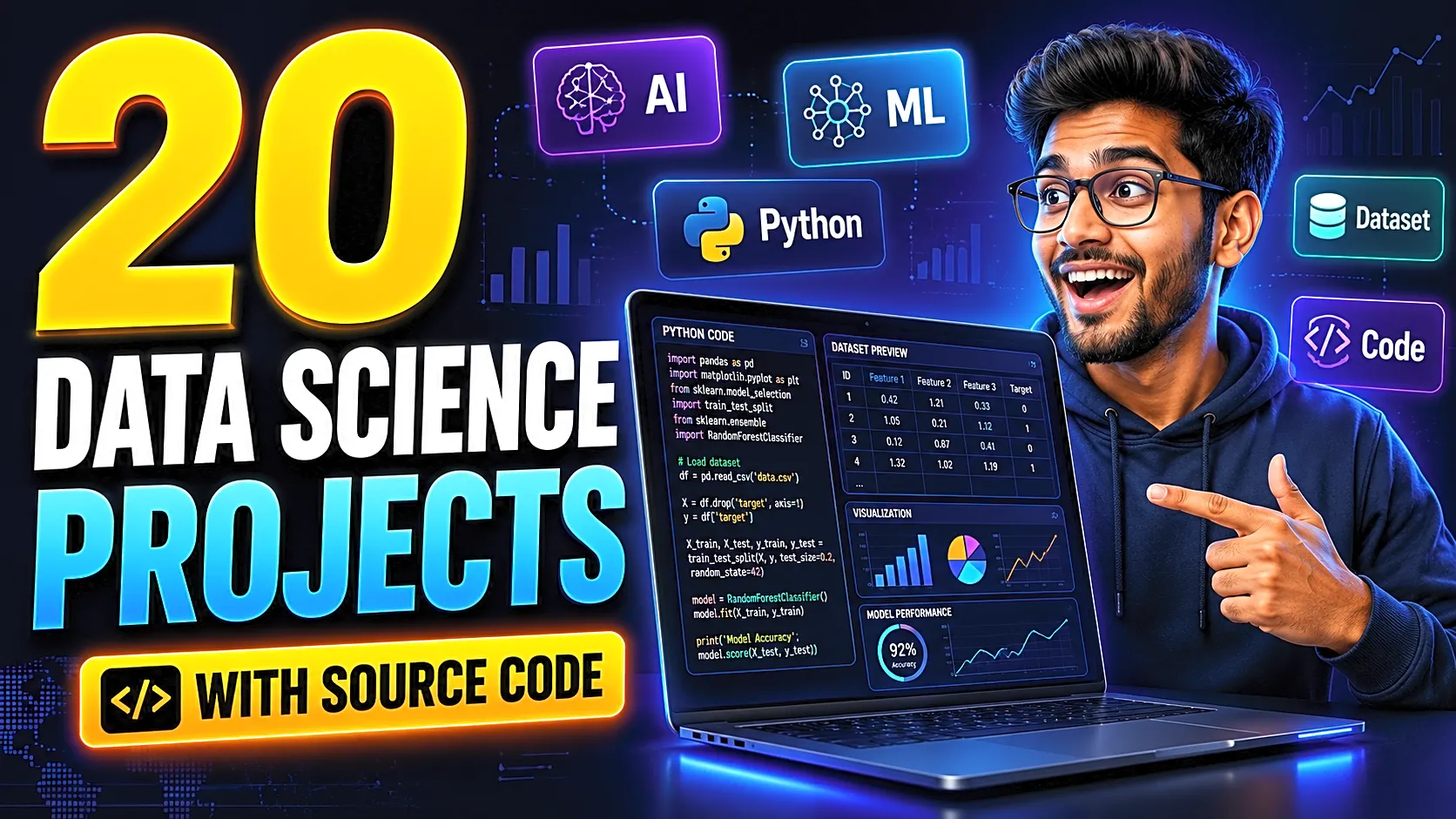
20 Data Science Projects with Source Code for Final Year Students
Choosing a final-year project becomes easier when you have a clear problem statement, dataset, tools, source-code structure, and viva explanation plan.
Quick Answer: The best data science projects with source code for final-year students include student performance prediction, fake news detection, customer churn prediction, sales forecasting, movie recommendation system, credit card fraud detection, heart disease prediction, crop yield prediction, sentiment analysis, resume screening, and brain tumor detection. Beginners should start with Python, Pandas, Matplotlib, and Scikit-learn. Advanced students can choose NLP, deep learning, computer vision, Flask, or Streamlit-based projects.
What Is a Data Science Project with Source Code?
A data science project with source code is not just a project idea. A complete project should include:
- Dataset or sample CSV file
- Python notebooks or .py files
- Data cleaning and preprocessing code
- Machine learning or analytics model
- Output charts, prediction results, or dashboard
- requirements.txt file
- Setup guide or README
- Final-year report, screenshots, and viva explanation
For final-year submission, the best project is not always the most complex one. The best project is the one you can run, customize, document, and explain confidently.
Best Data Science Projects with Source Code: Quick Comparison
|
Project |
Difficulty |
Best For |
Dataset Type |
Output |
|
Student Performance Prediction |
Easy |
Beginners |
Student records |
Marks prediction |
|
House Price Prediction |
Easy |
Regression practice |
Property data |
Price estimate |
|
IPL Data Analysis |
Easy |
Analytics project |
Sports data |
Dashboard |
|
Fake News Detection |
Medium |
NLP learners |
News text |
Real/fake label |
|
Customer Churn Prediction |
Medium |
Business analytics |
Customer data |
Churn risk |
|
Sales Forecasting |
Medium |
Time-series learners |
Sales history |
Forecast chart |
|
Heart Disease Prediction |
Medium |
Healthcare ML |
Medical data |
Risk category |
|
Crop Yield Prediction |
Medium |
Social-impact project |
Weather/soil data |
Yield estimate |
|
Credit Card Fraud Detection |
Advanced |
ML evaluation |
Transaction data |
Fraud alert |
|
Resume Screening System |
Advanced |
Placement-focused project |
Resume/JD text |
Candidate ranking |
|
Brain Tumor Detection |
Advanced |
AI/ML students |
MRI images |
Tumor classification |
20 Data Science Project Ideas with Source Code Direction
1. Student Performance Prediction System
Predict student marks using attendance, study hours, previous scores, and assignments. Use Python, Pandas, Scikit-learn, Linear Regression, or Random Forest. Add a dashboard showing predicted marks and risk category.
2. Fake News Detection System
Use NLP to classify news as real or fake. Implement text cleaning, TF-IDF vectorization, and Logistic Regression or Passive Aggressive Classifier. This is viva-friendly because you can explain tokenization, vectorization, training, and prediction.
3. Customer Churn Prediction
Predict whether a customer may leave a service. Use telecom or subscription datasets, classification algorithms, and churn probability scores. This project is strong for resumes because it solves a real business problem.
4. Sales Forecasting System
Forecast future sales using historical data. Use ARIMA, Prophet, Random Forest, or regression models. Add monthly and product-wise charts to make the output more practical.
5. Movie Recommendation System
Recommend movies using content-based filtering or collaborative filtering. Use genres, ratings, user preferences, and cosine similarity. This is one of the easiest data science projects to explain.
6. Credit Card Fraud Detection
Detect suspicious transactions using classification or anomaly detection. Use Logistic Regression, Random Forest, Isolation Forest, and confusion matrix evaluation. Since fraud datasets are imbalanced, explain precision, recall, and F1 score clearly.
7. Heart Disease Prediction System
Predict heart disease risk using age, cholesterol, blood pressure, chest pain type, and heart rate. Build a Flask or Streamlit interface where users enter values and receive a risk category.
8. Crop Yield Prediction System
Estimate crop yield using rainfall, soil type, temperature, humidity, region, and crop type. This is especially relevant for Indian students because it connects data science with agriculture.
9. Sentiment Analysis on Product Reviews
Classify reviews as positive, negative, or neutral. Use product review datasets, NLTK, TF-IDF, Naive Bayes, or Logistic Regression. Add word clouds and sentiment distribution charts.
10. Stock Price Analysis and Prediction
Analyze stock trends using moving averages and historical price data. For academic use, present it as analysis and forecasting, not financial advice. Add a disclaimer that predictions are educational only.
11. House Price Prediction
Predict property prices based on location, area, rooms, amenities, and past prices. This is a clean regression project and ideal for beginners.
12. Resume Screening System Using NLP
Rank resumes based on skill match, qualification, and job description similarity. Use TF-IDF, cosine similarity, skill extraction, and a simple HR dashboard.
13. IPL Data Analysis Dashboard
Analyze team performance, toss impact, venue trends, player stats, and season-wise results. This is a good analytics project without heavy machine learning.
14. Weather Forecasting System
Predict temperature, humidity, or rainfall using historical weather data. Add city-wise filters, forecast charts, and optional API integration.
15. Diabetes Prediction System
Predict diabetes risk using glucose, BMI, insulin, age, and blood pressure. Use Logistic Regression, KNN, SVM, or Random Forest. Add result history and downloadable reports.
16. Loan Approval Prediction
Predict loan approval using income, credit history, employment, loan amount, and applicant details. This project is useful for fintech and banking-focused submissions.
17. Zomato Restaurant Data Analysis
Analyze ratings, cuisines, locations, price ranges, and customer preferences. Use Pandas, Matplotlib, and Plotly to build an interactive dashboard.
18. Traffic Accident Analysis
Identify accident-prone areas, severity patterns, time trends, and weather impact. Add clustering or classification to make the project stronger.
19. Online Retail Market Basket Analysis
Find products frequently purchased together using Apriori and association rule mining. This project is useful for eCommerce analytics and recommendation systems.
20. Brain Tumor Detection Using Machine Learning
Classify MRI images as tumor or non-tumor using CNN, TensorFlow/Keras, or transfer learning. This is an advanced project, so include image preprocessing, model accuracy, confusion matrix, and limitations.
Dataset and Source Code Planning Table
|
Project Type |
Dataset Source |
Source Code Type |
Recommended UI |
|
Classification |
Kaggle, UCI, CSV |
Python notebook + model file |
Flask/Streamlit |
|
Regression |
CSV, UCI, public datasets |
Notebook + .pkl model |
Flask form |
|
NLP |
News/review/resume text |
NLP pipeline + classifier |
Web text input |
|
Forecasting |
Historical time-series CSV |
Forecasting notebook |
Dashboard |
|
Computer Vision |
Image dataset |
CNN model + upload module |
Flask image upload |
|
Analytics Dashboard |
CSV/API data |
EDA notebook |
Streamlit/Plotly |
UCI is a reliable source for many classic machine learning datasets, including heart disease, student performance, bank marketing, and online retail datasets.
Sample Source Code Folder Structure
A good final-year data science project should be organized like this:
project-name/
│── app.py
│── model.pkl
│── dataset.csv
│── requirements.txt
│── README.md
│── notebooks/
│ └── model_training.ipynb
│── templates/
│ └── index.html
│── static/
│ └── style.css
│── reports/
│ └── final-year-project-report.pdf
This structure helps your evaluator understand how the project works and makes the viva easier.
How to Build a Data Science Project Step by Step
Step 1: Choose a Clear Problem Statement
Define the input, processing, and output. Example: “Predict whether a customer will churn based on usage, billing, and service history.”
Step 2: Collect a Dataset
Use Kaggle, UCI Machine Learning Repository, government datasets, or manually created CSV files. Make sure the dataset has relevant columns and enough records.
Step 3: Clean and Prepare the Data
Handle missing values, duplicates, incorrect formats, outliers, and irrelevant columns.
Step 4: Perform Exploratory Data Analysis
Use charts, correlation heatmaps, summary statistics, and visual dashboards to understand the data.
Step 5: Train the Model
Choose the algorithm based on the problem:
- Regression: price, marks, sales prediction
- Classification: fraud, disease, churn, approval
- Clustering: segmentation
- NLP: text classification
- CNN: image classification
Step 6: Evaluate the Model
Use suitable metrics. For classification, use accuracy, precision, recall, F1 score, and confusion matrix. For regression, use MAE, RMSE, and R². Scikit-learn’s metrics module supports classification and regression evaluation functions.
Step 7: Build the User Interface
Use Flask, Django, or Streamlit. A simple form-based interface is enough for many final-year projects.
Step 8: Prepare Report, PPT, and Viva Notes
Include synopsis, SRS, dataset description, algorithm explanation, architecture diagram, DFD, ER diagram if needed, testing, screenshots, conclusion, and future scope.
Best Project by Student Type
|
Student Goal |
Recommended Project |
|
Easy viva |
Student Performance Prediction |
|
Beginner-friendly project |
House Price Prediction |
|
Resume project |
Customer Churn Prediction |
|
NLP project |
Fake News Detection |
|
Healthcare project |
Heart Disease or Diabetes Prediction |
|
Advanced AI/ML project |
Brain Tumor Detection |
|
Business analytics project |
Sales Forecasting |
|
Final-year major project |
Resume Screening or Fraud Detection |
Common Mistakes to Avoid
- Downloading code without understanding it
- Using a dataset without cleaning it
- Showing only accuracy and ignoring precision or recall
- Choosing a project that is too advanced to explain
- Not preparing screenshots and documentation
- Not testing setup before submission
- Ignoring limitations and future scope
Expert Tips for a Better Final-Year Project
Choose a project where you can explain every module confidently. Add a dashboard, compare two or three algorithms, and include screenshots of outputs. For stronger submissions, add user login, admin panel, database storage, report download, or CSV upload features.
Need a ready-to-run project with source code, database, documentation, and setup support? Explore FileMakr’s final year project source code collection.
FAQs on Data Science Projects with Source Code
1. Which data science project is best for final-year students?
Fake news detection, student performance prediction, customer churn prediction, heart disease prediction, resume screening, sales forecasting, and fraud detection are strong choices.
2. Which data science project is easiest for beginners?
Student performance prediction, house price prediction, IPL data analysis, and Zomato data analysis are beginner-friendly.
3. Where can I download data science projects with source code?
You can use open-source repositories or ready-to-run project platforms. For academic submission, choose code that includes setup files, dataset, documentation, screenshots, and viva guidance.
4. Which dataset is best for a data science project?
The best dataset depends on your topic. UCI is useful for classic ML datasets, Kaggle is useful for broader real-world datasets, and custom CSV files work for college-specific projects.
5. Should I use Flask or Streamlit?
Use Flask if you want a web application with routes, templates, and forms. Use Streamlit if you want a fast dashboard-style data science interface.
6. What files should be included in the source code?
Include Python files or notebooks, dataset, trained model, requirements file, README, templates/static files, and documentation.
7. Do data science projects need a database?
Simple projects can use CSV files. Advanced projects can use SQLite, MySQL, or MongoDB to store users, predictions, uploads, and reports.
Conclusion
Data science projects with source code are excellent for final-year students because they combine Python programming, analytics, visualization, machine learning, and real-world problem solving. Beginners should choose simple projects like student performance prediction or house price prediction. Advanced students can choose resume screening, credit card fraud detection, crop yield prediction, or brain tumor detection.
The best project is one you can run, customize, document, and explain confidently during your final-year viva.